Tuesday, January 03, 2006

Kinski Interview

with Chris Martin, Matthew Reid Schwartz, Lucy Atkinson & Barrett Wilke
@ Berbati's Pan (Portland, Oregon) September 2002
photo & text: Dan Cohoon
When I am asked to describe Kinski I say they are the west coast Bardo Pond--which, coming from me is a very high compliment. They are not derivative of Bardo, but they share the ability to alter your whole being through music alone. If you ever need your head cleared out, put on “Semaphoreoff their album Airs Above Your Station. After the six minutes pass, you can not help but be in a great mood. That is the song I feel in love with Kinski for much like I fell in love with Bardo Pond the first time I heard “Dragonfly Lying on the Floor”. Live is the best way to experience them. Chris says he tries to craft the sets like a roller coaster ride. It is quite an amazing ride. I sat down with them in the early fall of 2002 at Berbati's Pan. Besides making extremely nice music, they are extremely nice people as well. –Dan Cohoon (September 2002)
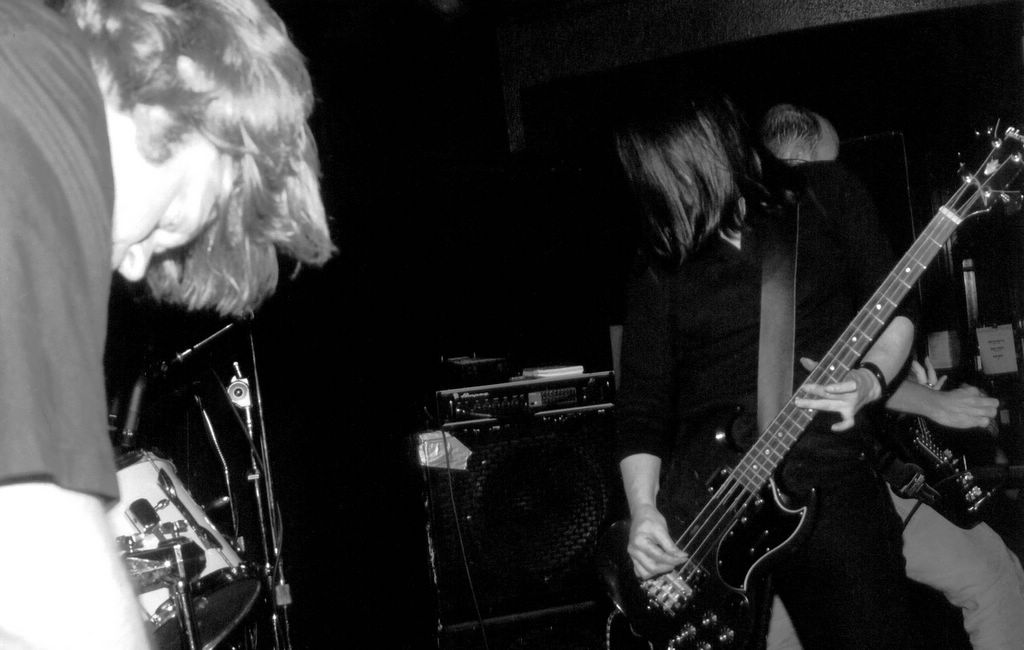
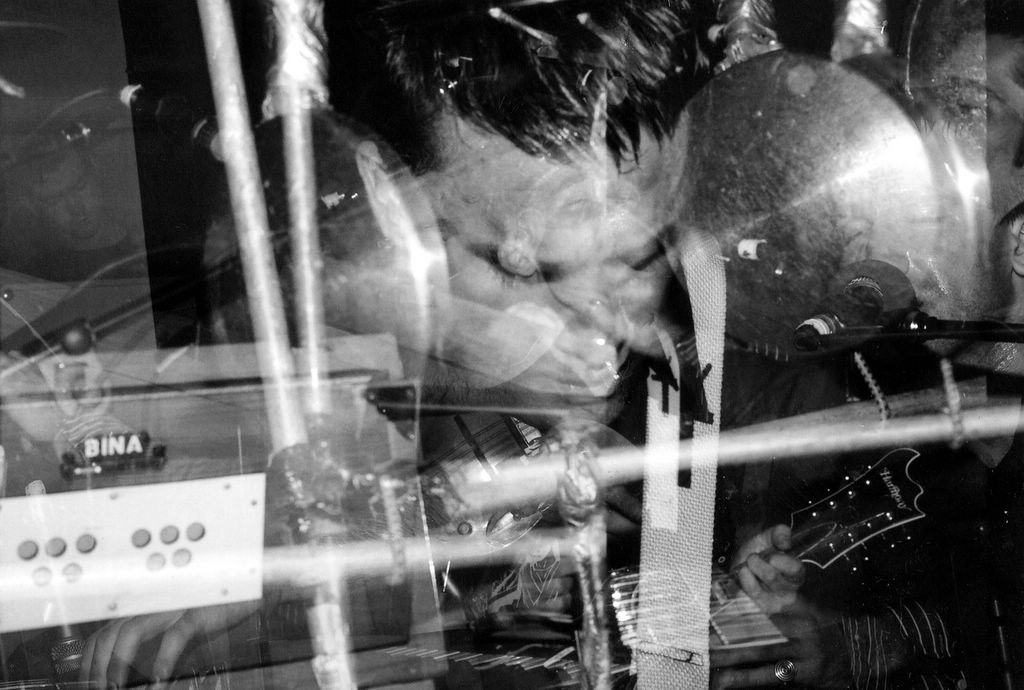
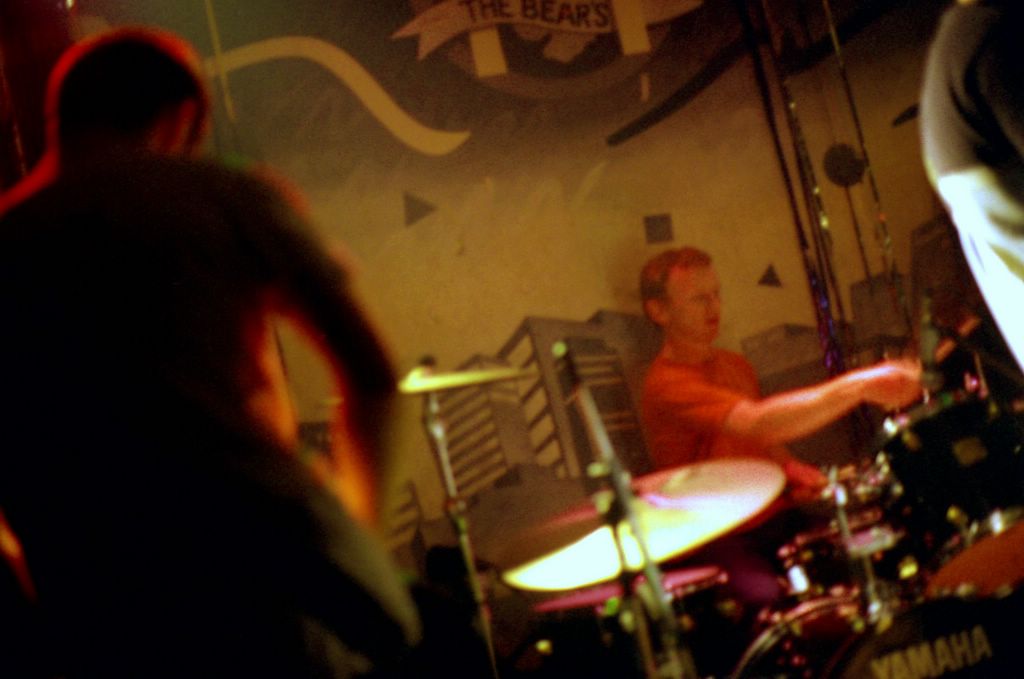
Kinski @ Berbati's Pan (Portland, Oregon) September 2002
Photo: Dan Cohoon Posted by Picasa
Dan Cohoon: When did Kinski start & what bands were you in before?
Chris Martin: We started in 1998. I was in a pop band in Seattle called the Deflowers which I don't mention much. I was in some college bands in Bozeman. This is Lucy's first band. Matthew the guitar player was in a couple power-pop type bands in the early 90's--one of them was called Sugarbuzz. Our old drummer was David Weeks and our new drummer is Barrett Wilke. He used to be a drummer for this band called This Busy Monster. We all come from a pop background.

DC: Who is Klaus Kinski?
CM: It was sort of a joke. I was and still am hugely into Krautrock stuff. My friend said we should call ourselves the Klaus Kinski after the actor. It was just a play on that. Someone just making fun of our German rock thing....

DC: Are you guys originally from Seattle?
CM: I am from Denver originally. Matthew is from New York City. Lucy is from Montana. Barrette is the only one originally from Seattle.

DC: How long have you lived in Seattle?
CM: He and I have lived there for twelve years. I got there right before Nirvana got signed and the whole grunge thing happened and I was kind of stuck.

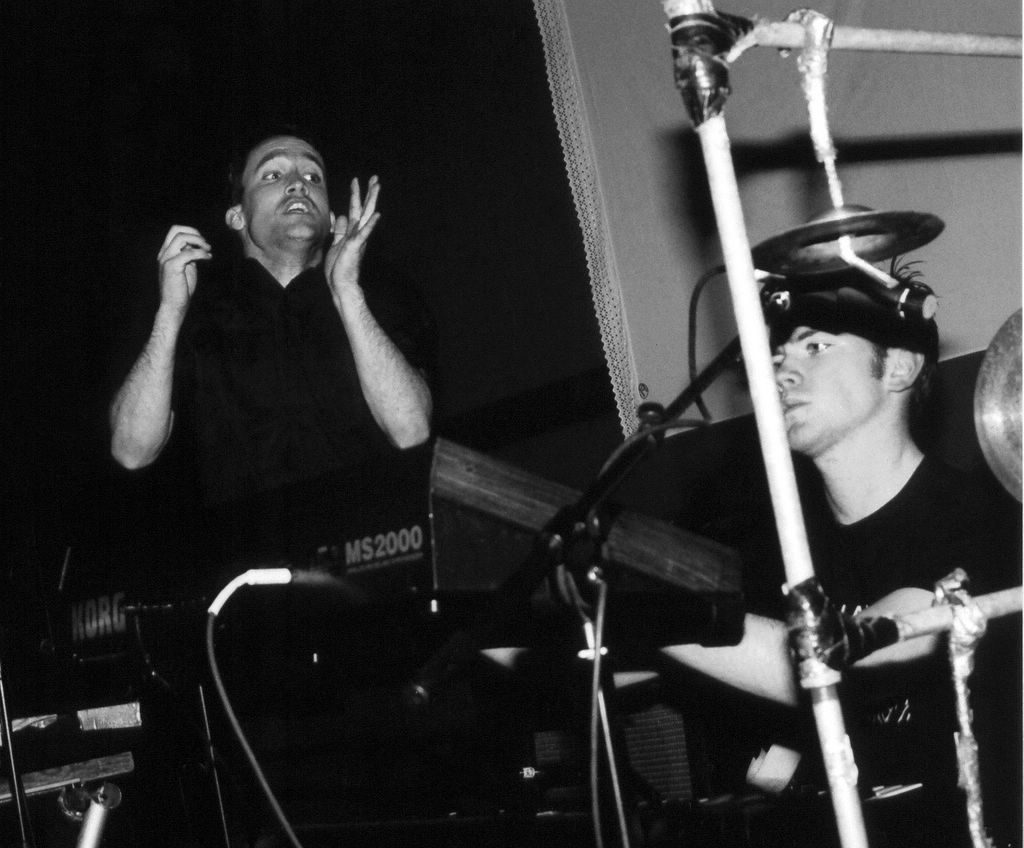
Chris Martin @ Berbati's Pan (Portland, Oregon) September 2002
Photo: Dan Cohoon Posted by Picasa
DC: How did that affect your music or how did that affect you with all that going on around you?
CM: Seattle was a horrible place to be then musically, I think. Matthew might have a different opinion. It was the wrong place, wrong time for power pop stuff. There were other places in the country you could be but Seattle was the wrong place. Now it is sort of the right place for that sort of stuff. For me it was totally the wrong place at the time.
Matthew Reid Schwartz: I would agree to some extent. For me it was an exciting place to see music. Obviously there was a lot of music happening-- while it wasn't what I was into; there were a lot of bands coming through. There was sort of an exciting feeling. I was in a power pop band too, and it was more difficult then, not just because of everything else that was happening.

DC: I have noticed that a lot of the avant rock on the west coast is more jazz-influenced (especially here in Portland, Oregon) while you guys are much more rock-oriented. When I hear you guys I think more east-coast space-rock from, say, Boston or Philly. Who do you identify with sound wise?
CM: Definitely Bardo Pond. The three of us, I don't know about Barrett, are just big fans of what they do. The whole Japanese bent of things, Acid Mothers Temple, Fushitsusha, Mainliner & High Rise. We played with all those bands and toured with some of them. It is a huge influence on me. The space-rock thing there is not a lot of current stuff that we are listening to but all the obvious things like Spacemen 3.
MS-R: It is interesting, I think it is fairly accurate, your question. Thinking about bands like Jackie-o Motherfucker, I am thinking of influences in a more experimental vein whereas Kinski is very space rock. I think we have an element, not to say jazz, but more sort of ambient improv.
CM: When you say jazz I think sort of prog. There are bands that play in Seattle that are sort of out-rock but it’s got a real proggy tinge to it. Not sort of Neu! And Orb mixed with space rock, which is what we identify more with. I think there are definitely more interesting bands here in Portland.

DC: Terrastock was the first time I saw you guys. How did you meet up with those people and what were your impressions of the festival?
Lucy Atkinson: I thought it was great. We saw every band there actually. It was really fun.
CM: We were just kind of fans of the magazine. When are first record that we put out came out we just sent it to Phil (the main guy behind Terrascope). He immediately sent us a letter back saying that he liked it. He is amazing because he seems like such a huge music fan and also pretty accessible and he gets back to people. The festival I thought was amazing. Matthew missed a lot of it because he was sick.
LA: We wish there were more Seattle representatives not playing but in the audience. It was kind of disappointing.
CM: All these people from the east coast....
LA: flew in for it. There were not a lot of local people who knew anything really about it.

DC: I felt like I was at a show in Boston.
CM: We didn't know anyone there. We didn't know a lot of the bands. We knew Bardo Pond and a couple other people. We didn't play till Sunday. So we were not really talking to people too much. It was kind of strange being in Seattle & not knowing anyone there, which was actually kind of cool.
LA: We are going to go again in October to Boston

DC: You use a lot of pedals. Do you find pedals freeing or restrictive?
CM: Except for battery costs (laughs). It opened up a ton of ideas. I used to plug directly into the amp kind of thing. I think unless you are a really great player or super creative it’s hard.
LA: Even Nels Cline who is a really great player has lots of pedals.
CM: Have you seen him play?
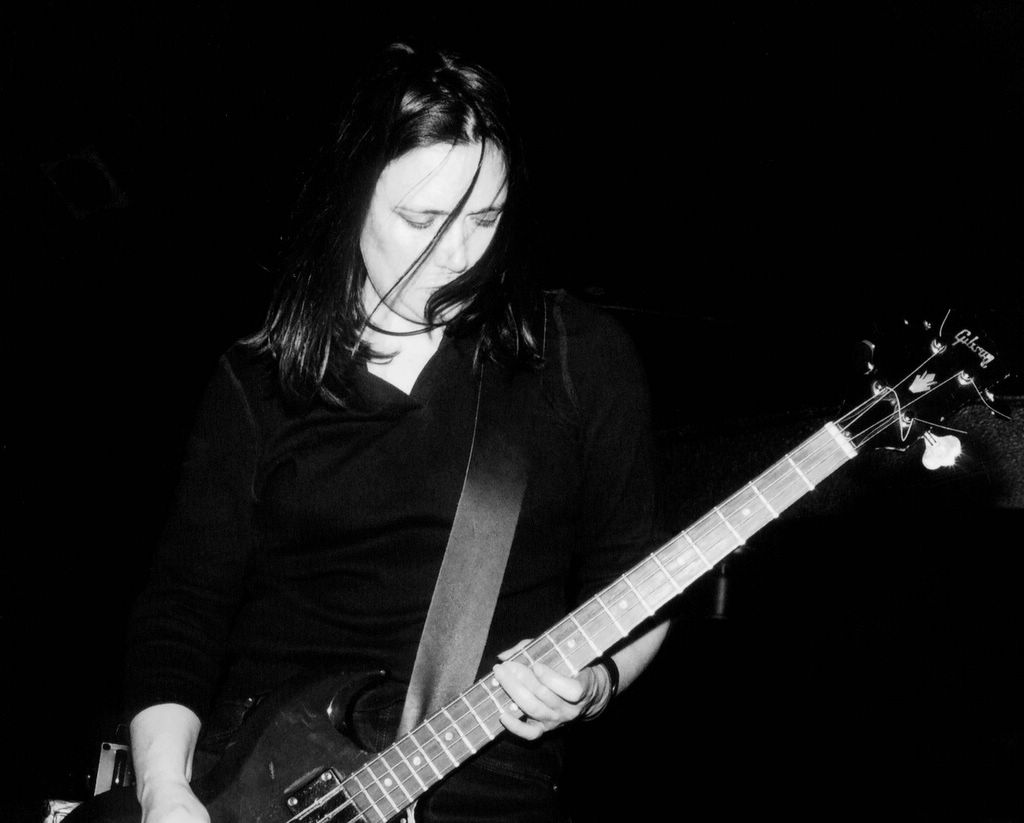
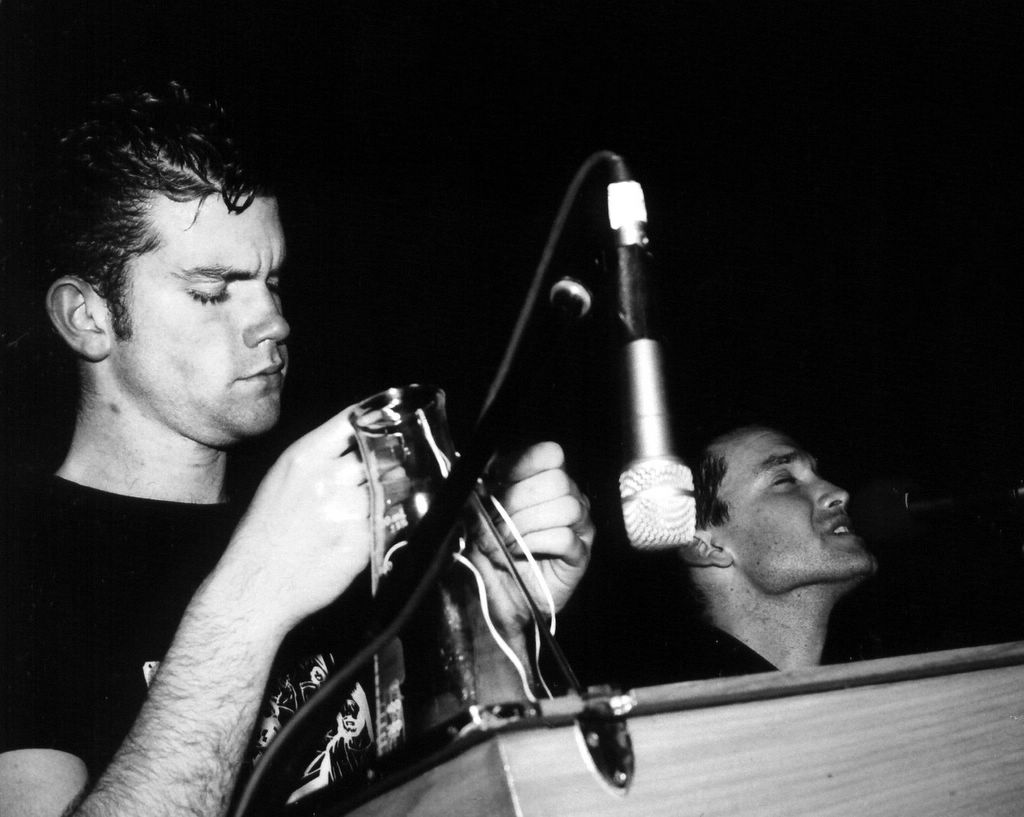
Lucy Atkinson @ Berbati's Pan (Portland, Oregon) September 2002
Photo: Dan Cohoon Posted by Picasa
DC: Yeah.
CM: He is so amazing. I am all for pedals. How about you?
MR-S: I am all for pedals. I am less involved with them than Chris. I guess I sometimes see my role… I guess there are two things--the opportunity is there to explore that. I think sometimes I want to step back to add a little bit less effected sound. It is such a learning curve as well because you have so many options. It is easy to get lost in it. I think it is a real challenge to work with it until you find something good.
CM: I think it is the song. I think the goal is to have the casual listener not know anything has changed. People in bands will notice it sonically. Do you play?

DC: Yeah I play prepared guitar. Sometimes when I use pedals I feel like I am cheating.
LA: I don't think so though. It is all about just experimenting with sound. If you are in a power pop band you don't really need all that. If you are in a band that wants to experiment with sound to see what it can do then pedals help to do that, to make it more interesting. You have a wider palette of sound to choose from.
MR-S: Some times I see bands that use pedals to over-saturate a sound. That doesn't particularly appeal to me if it is just a barrage of that process.
CM: Some one like Keiji Haino uses tons of pedals to get the full thing with one big roar which is interesting.
MR-S: I agree, I guess I am talking more about when it is used to an effect that doesn't distinguish itself. It is potentially something that is easy to use that doesn't distinguish your sound; it just creates another sound that is just flat.

DC: I have only seen you guys live. Tell me: how does your sound on records differ from when you play out?
CM With the records we spend a lot of time on making the records in the traditional studio sense. A lot of people told us that Be Gentle with the Warm Turtle did not capture our live sound at all. We see it as two different things. We want to make a really beautiful record.
LA: That you would want to listen to at your house.
CM: That kind of flows. We try and do that with our sets but we want them to be a big powerful rock thing. The new record is kind of a trajectory and is planned out. The recorded and live thing is pretty different. We are trying to get it so both live and the record is the same sort of thing.
DC: When I see you guys live it is very cathartic. I feel really great after your set. Is that intentional? Are you trying to affect the mood of people?
CM: It is intentional in the sense that we structure sets so they are not boring. If there are mellow things it is like a roller coaster. Some shows it feels like we are on a roller coaster with no brakes. It is awesome to hear that from you--that it is a cathartic thing. I don't know how we can plan that exactly.
LA: We could say that we plan it (laughs).
MR-S: It is in a book we once read.

DC: How to rawk out.
MR-S: I would like to think that at are best when we play live--it is cathartic for us as well. We all have the ability to really get into the music, which is hopefully what bands do all the time. Not to say they don't. Like Chris said it is very gratifying to hear that. It can also be really gratifying to be playing that.
CM: When we first started playing (before Matthew joined us) people would give us shit “Oh you don't talk to the audience. You are building this wall between you and the audience.” We don't do the typical, "Hey how is everyone doing tonight? We got t-shirts out there." Nobody gives a shit about that. Everyone’s been to rock shows to know how it all works.

DC: How do you go about constructing a song?
CM Can you take that one? I am going to get another beer.
LA: Me? Well I come up with all the ideas (laughs). We have two different ways we go about it. With some songs they start out as just sort of jamming (making it up as we go along). We tape as we play. We go back & listen to it and hear what we like. It is kind of a group writing process. Most songs, Chris gets some sort of idea and he brings it to us. We all play around with that idea. We tape it & talk about where we want it to go or how it is doing & structure it that way. We tape everything then Chris will take it back again & play around with all the ideas we generated. He then brings it back and we finish it off.

DC: Your songs are very structured but you have improvised parts. How do you go about balancing the two?
CM: I think that there is less improvisation than what it seems; at least that was the case a year ago. Now we are trying to work that in. Tonight there is a section where everyone can do whatever. We have been doing this alter ego thing called Herzog. This is all of us playing improv at separate shows. We are trying to develop that. Right now that is pretty much separate from Kinski. Hopefully that will interweave more. I don't think we have that much improv.
LA: We have a little.
MS-R: In some respects more with Lucy and me. Maybe it is not quite improv, parts where we are making sounds. I think there are a couple of very gratifying moments playing off each other. We know how we are approaching it; we are not necessarily changing technique. Like you said the songs are very structured so there is a set time when this stuff is happening.
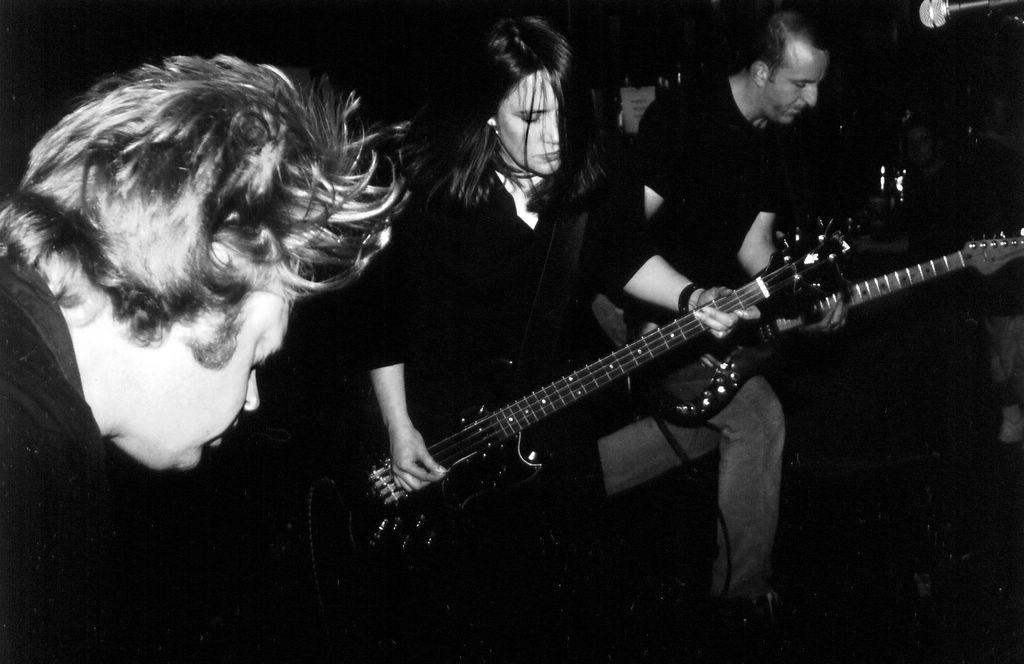
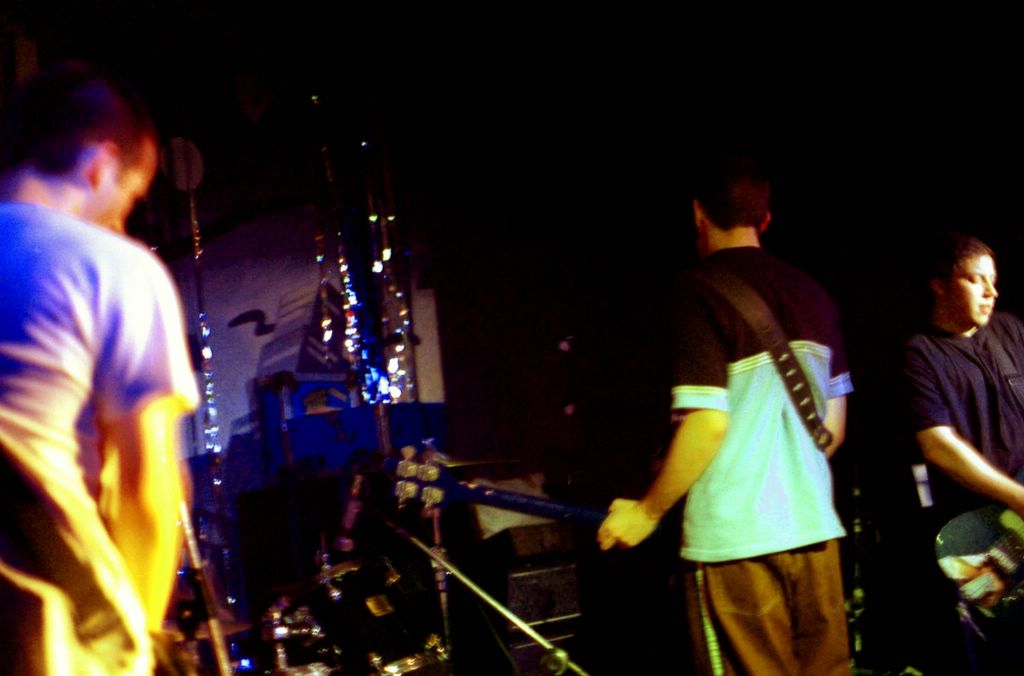
Kinski @ Berbati's Pan (Portland, Oregon) September 2002
Photo: Dan Cohoon Posted by Picasa
DC: There are sections of the songs where there is, maybe not random stuff but not really tight stuff either.
CM: You might be talking about the parts that we want to be super tight but are playing really, really poorly (every one laughs).

DC: You were talking about melding the improv with the rock. Is there anything else you are looking to do?
CM: I use a Big Muff distortion pedal and on the last two records it was all over them. I want to get away from that. Maybe have things a little quieter occasionally, not always having to rock.
LA: Except the two new songs there is a lot of rocking.
CM: Yeah… We can never seem to plan it. Barrett has been with us only a month. Things have already changed. The new material is going in a different direction, and I am not even sure what that direction is yet.

DC: (to Barrett) You are the new addition to the band. How are things going?
Barrett Wilke: I started a few months ago. Things are going really good. I was struck by how things seem unplanned but are very planned out and secondly the use of space. It is very different—sometimes the best effect we are using is space--at other times it is a lot of notes clustered together. It is fun to do really heavy stuff and really stretch it out. I like when we talk we don’t say how many phrases or bars but how many minutes it is going to go on for. I like the extended structure that struck me right away.
MS-R: Sometimes we talk about how many cycles of the sun for particularly extended pieces.

Monday, January 02, 2006

Xiu Xiu Interview

Interview with Jamie Stewart, Jherek Bishoff & Sam Mickens
Conducted @ The Blackbird (Portland, Oregon) Fall 2002
Photos & Text by Dan Cohoon

Sometimes sad songs are the only songs that make you feel any better. Sometimes angry songs are the only songs that make you happy. The summer 2002 I listened to Xiu Xiu: Knife Play almost non stop. It is one of those dark summer records that haunt you for years after. I sat down with the fine folks in Xiu Xiu and was pleasantly surprised that they were not all doom and gloom. They were pleasant, even funny. -Dan Cohoon

Cover Art for Chapel of Chimes Posted by Picasa
Dan Cohoon: How long has Xiu Xiu been together?
Jamie Stewart: Xiu Xiu has been a band for two years, of this November and Sam & Jherek have been in the band since the beginning of this last tour for about a month.

DC: You incorporate lots of different genres in your music. Did you set out to do that?
JS: Having disparate elements to exist in the band wasn't totally an intellectual process initially. It is hard to say. There are three kinds of main influences and I would be interested in maintaining those three influences. It wasn't the plan innately. There is defiantly gay house music. Then there is death obsessed 80's British pop and then there is modern classical and experimental electronics and free jazz stuff. Those are the three types of music I listen to most. (pause) I am totally not answering your question. Just make up an answer. You might want to ask Sam & Jherek what their plans are. They are going to be writing stuff also.

Xiu Xiu @ The Blackbird 2002 (Portland, OR)
Photo: Dan Cohoon Posted by Picasa
DC: How is the songwriting divided up? Are you the main songwriter?
JS: That used to be the case. But you might want asks them what their plans are for influences for the future.

DC: What influences do you see the band taking on?
Jherek Bishoff: I am personally really into modern classical, free jazz and experimental things. I like 80's Britpop
but I am not well versed in it. I am interested in what will happen when we start writing songs together. I write stuff that is like lots of chords and lots of melodies and sub-melodies to it. Jamie does too. I was talking today how lots of his stuff is that lots of his chords are real simple and what is going around it is very complex, whereas my stuff is more chord oriented. For me it is going to be interesting to see what is going to happen.
Sam Mickens: I think all those elements should stay in Xiu Xiu. I can imagine there being more organically weird stuff, acoustically weird stuff, as opposed to just computer music. There is lots of that in the recordings but I can see that being taken even further.

DC: As far as playing what is your set up on stage?
JS: Assload of stuff. Anything that is heavy, uncomfortable to carry and inconvenient to tune is what we use. That is sort of the criteria that if it is a pain in the ass to use on stage we are going to use it. Harpsichord, Sousaphone, Pipe Organ, Pump organ...
SM: Stalactite Organ.
JS: We have this wire that is 7,000 miles long that we have nailed to a post here and nailed to a post at our apartment that we also put contact mics on…Bombs sometimes.

DC: For people that write really depressing music. I don't see you guys as that depressed. Is the song writing out of an abstract experience or is it personal?
JS: It is very, very definitely personal. All of the stuff is about real stuff that has happened to people that are close to us or stuff that has happened to us specifically. I am really mostly irritated by and completely uninterested artistically in things that are not totally realistic. I really don't see the point in making something up I… guess. That makes me sound like a total dick. Any music that I have ever listened to that has been really; really important to me is music that defiantly seems to be about somebody's singular and real experience. It would feel bad to me to make up a song about finding a bloody sock. It just seems totally pointless, because music is something that is totally physical and totally emotional. Making something up in that sphere seems to be the wrong thing to do.

DC: We just had the Electroclash tour come through town. To me that whole genre of music is really empty and something that I just can't get my head around. I don't get it. You were also influenced by the dance music of the 80's. I was never really happy in the 80's and I don't really have good associations with that type of music.
JS: With the exception of Peaches everyone who is making that type of music is like 20. So its not really people who had direct contact with what the music was about at that time. Any one who is doing the recurrent subgenre like Gang of Four stuff is people who were not alive at the time. They are looking back at it in a kind of fond way as opposed to something at the time had very real political and emotional feelings. If I look back at say Petula Clark it seems really campy and cute to me. But I am sure at the time she really meant every syllable of “Downtown.”

DC: How do you feel about nostalgia?
JS: As a genre of music?

DC: There seems to be with the whole 80’s recurrence a group of people who are definitely exploring the same thing. Your take on it is different from 99% of what is going on. The rest of them are very campy and light, whereas you guys are taking the darkest elements of it.
SM: I don't know if it is such an issue in Xiu Xiu of looking back at the 80's. A lot of that music has had a tremendous effect on all of us. As far as the dance music elements in Xiu Xiu, it is more about being that music, being in the club and all the feelings that go into that. As opposed to the craft of electronic music or the nostalgia of music that used to sound like that.

Xiu Xiu @ The Blackbird 2002 (Portland, OR)
Photo: Dan Cohoon Posted by Picasa
DC: Like the physical?
JS: Dancing at clubs is a tremendous influence on Xiu Xiu, just all the mixed feelings that go into that. You get this hyper euphoria from dancing for a while and then you get super, super, super insanely depressed. (Interrupted by sound man telling them they can set up) It is about going to dance clubs right now. It is not about looking back at all. It is a very current real experience. How great it is and how depressing and sad it can be.

DC: How did you get into music?
SM: For me as a kid I listened to lots of middle age pop music with my mom, then crazy really hard core punk stuff and heavy metal and rock stuff from my brother (Pop stuff like the Beatles and the Staples). At 12 or 13 I got into jazz and pretty much right away got into experimental jazz and later on experimental classical.
JB: It is really similar for me. My first tape was MC Hammer. My dad was really into experimental music. He bought me a Rahsaan Roland Kirk and was like; this is what you should really listen to. I was immediately blown away by it. So I listened to that along with MC Hammer, the Beatles from day one. I got even into death metal for a while. Then I got into jazz and experimental jazz & classical.
JS: Big fucking surprise: the first record I had was a Beatles record. When I was in 9th grade I started listening to a lot of dub and reggae. I was obsessed with the radio growing up. But that was the first genre of music that I was into. In high school I was super crazy, crazy into Goth. I never really listened to rock particularly (specifically I never really was into metal or anything like that). At that time I really got into field recordings of different indigenous music. I never really knew if it was good or bad in that type of music. I never really thought too much about it. And then I got super into industrial and stuff like that. In my early twenties I started getting into A Love Supreme. In the last three or four years I got really into avant-classical stuff. I got into house music and stuff like that in the last two or three years. Where I lived for the last couple of years there were a lot of pirate radio stations that played a lot of dance music.

Xiu Xiu @ The Blackbird 2002 (Portland, OR)
Photo: Dan Cohoon Posted by Picasa
DC: You kind of already sort of answered this question: where do you see Xiu Xiu going?
SM: I think we all share a mutual interest in experimenting with songs that are built up less with the computer and prerecorded less with the computer and based more on unusual instrumentation and unusual parts.
JS: Having that stuff but still having it be pop songs.
SM: Hopefully Xiu Xiu will be able to integrate more and more experimental influences while staying completely pop.
JS: I am personally interested in doing more...taking the different influences we have more, but doing them more extremely in explicit kind of ways. Like doing stuff that is more dance or more experimental or more pop. I am definitely interested in having like half the Xiu Xiu songs be good pop songs that you can play on guitar by yourself with kind of dissonant and experimental sounds. Then do stuff that, although it has singing and stuff, you could never play by yourself on your guitar by your window when it’s raining.

Links:
Xiu Xiu
Absolutely Kosher
5 Rue Christine
Kill Rock Stars

a=1/f squared * archives * phonography * photography * links

Friday, December 30, 2005

Mogwai Interview

interview with Stuart Braithwaite
via e-mail (1998) & Phone (1999)
text & photos by Dan Cohoon

Mogwai @ T.T. the Bears (circa 1997)
Photo: Dan Cohoon Posted by Picasa
Dan Cohoon: How has growing up in Scotland affected your musical outlook?
Stuart Braithwaite: I don’t honestly know as I have never lived anywhere else.

DC: How are you received by fans and press in Scotland vs. the United States?
SB: People have been more than kind to us both here and in America.
DC: Is there a main song writer in the band or is it more of a collaborative effort?
Most of the songs are written by either Dominik or me, or as collaborations. John did write a song on the LP (Radar Maker). We are all doing stuff at the moment.

DC: Are the songs planned out or do they spring forth from improvisation?
SB: Some were born during improvisations (“Helicon” & “Fear Satan”) but a lot were written at home.

DC: Do you prefer playing live or in the studio? Do you play live in the studio or do you lay down tracks separately?
SB: We like and hate both. I personally prefer live but it gets tiring. We always try and play live in the studio.

DC: Talk to me about the song “Tracy” on the Young Team album. Is this phone call in the song some one you know, or was it picked up on a scanner? It is one of my favorite songs on that album.
SB: It is a hoax call between our drummer and our manager.

DC: When I saw you play @ T.T. the Bears in Cambridge, MA USA. The crowd reacted very positively towards you. They remained quite during the quietest parts of your set. Do you always get that good of a reaction from a crowd or do you have problems with them being too chatty during your sets.
SB: People vary in different towns. It is nice to be polite.

DC: The piano is featured more on Young Team than on Ten Rapid. Is there any other musical instrumentation you wish to incorporate in future projects?
SB: It was lying about the studio. We want strings and children’s choir on our second LP.

DC: Your music is so emotionally charged. Are these compositions based on real events or are they more abstractly based?
SB: Totally abstract, just music. Make of it what you will.

Mogwai @ T.T. the Bears (circa 1997)
Photo: Dan Cohoon
Posted by Picasa
I did a second interview with Stuart Braithwaite over the phone in the winter of 1999 just as Mogwai was about to release Come On Die Young. -Dan Cohoon

DC: Tell me about the new album?
SB: It’s called Come On Die Young. It has 12 songs, it’s a lot quieter than the last one (ed. Young Team). This fist song got a big kinda speech that we took from
Iggy Pop interview in the 1970’s
DC: Why did you record in the US?
SB: I think we really needed to be away from any distractions…Had the opportunity to just get on with things, than rather kinda forget to go and stuff.

DC: How did you like upstate New York?
SB It was kinda nice, it was quiet. It wasn’t really jumping.

DC: Tell me about the album title Come on Die Young.
SB: The gang Come On Die Young was the gang that Barry, our new keyboard player, his dad was in, in the 1960’s.

DC: I guess they are a little bit different than the US versions?
SB: Of gangs? (Laughs) Yeah…They are very different. I don’t know any real American gangs. People in Scotland don’t really have guns. That’s a pretty major difference. They don’t shoot ya; they just kinda stab ya…much more stabbing.

DC: Tell me about the “No Education=No Future…Fuck the Curfew” EP. What role do you see the musician to effect political change?
SB: Not really any to be honest that was just something we felt strongly about. We never really had any agendas as to what would happen. It turns out nothing happened. The main thing we did make little stickers that said “fuck the curfew.” We probably pissed some people off. So we pissed some cunts off. That is really as far as things went.

DC: Tell me about “Kicking a Dead Pig.” I grew up listening to mainly classic rock, so I don’t have much knowledge of dance music. I really like that album because it’s really not danceable.
SB: No, no, no, nothing we ever did was it possible to dance to. It’s always too slow. We really liked classic rock as well. At the same time we really like the music like Kraftwerk & Aphex Twins, that kind of thing.

DC: On “Young Team” there are several biblical references in the song titles. I was just wondering what kind of religious upbringing you had and what effect it had on your music.
SB: The only member of the band who is religious is Dominic. He is a Catholic. I suppose things like “Mogwai fears Satan,” that’s kinda of connected directly to Dominic’s fear of the devil from his Catholic upbringing, which kind of continues to this day. None of the rest of us is religious at all.

DC: What kind of music were your parents into?
SB: I don’t know. Just kinda folk music & Scottish traditional music, My Mum’s from the highlands. She listens to a lot of Gaelic music. I don’t know if that made an impact at all.

DC: The song “Tracy” uses a crank phone call. Who was it on and what was the joke?
SB: That was Martin, our drummer, fooling up are manager Colin, telling him that me and Dominic had a fight and that the band split up.

DC: How long did you pull his leg for?
SB: For about 15 minutes. He started phoning people up, it got quite complicated.

DC: What kind of music did you listen to growing up?
My favorite band growing up was probably The Cure. Then I really got into bands like Dinosaur and Nirvana (those kinds of things). I really liked Bauhaus & Sonic Youth. I got really into them.

DC: Which instruments do you play?
SB: I play the guitar. Sometimes I play the drums, the bass and the piano as well.

DC: You also did some of the remixing on Kicking a Dead Pig? Did you have any experience before doing that, with that sort of thing?
SB: I did some music in college. So I know how to work computers and sequencers and stuff. That’s really the only experience before that. I did some remixes since then as well, David Holmes, Paradise Motel, Manic Street Preachers.

DC: How do you guys like playing in the US?
SB: It is pretty nice. A lot of bands come over from Britain and they play to absolutely no one. When ever we play there are always some people there. That is good. It not that different then playing here than Britain. I quite enjoy it. We don’t play really big shows. We can’t afford to bring as many sound guys as we normally have.

Mogwai @ T.T. the Bears (circa 1997)
Photo: Dan Cohoon
Posted by Picasa
DC: Is the set up different?
SB: There is usually more when we play in Britain. When we play Britain we have more stuff going on. Our sound guy puts the whole mix through an analog keyboard. He’s got lots of tape loops and shit, as well.

DC: How did you guys choose to do the new album on
Matador?
SB: It seemed like a good idea. To be honest we sorted that out after we finished the record. We just try and do these things to the best we can. It seemed like the best thing to do. It seems to be working out pretty well too.

DC: What is different from the album Come On Die Young and Young Team?
SB: It’s just a progression really. We just left a lot of the stuff that was becoming quite repetitive, we kind of stopped that. We are trying to make stuff a bit more interesting, changing a lot of the time changes, and a lot of new sounds.
DC: What kind of sounds?
SB: Just sampled things and just mixing them around, mixing things backwards.

DC: On the first song on “Young Team” what is that speech from?
SB: That’s a friend reading out loud a review we had in Norway….a bit over the top. We kind of just exploit that.

Links:
Mogwai
Matador Records

Monday, December 26, 2005

Come Interview

interview with Thalia Zedek & Chris Brokaw
@T.T. the Bears, Cambridge, MA (circa 1997)
photo & text by Dan Cohoon
Come was a Boston based band. It featured Thalia Zedek & Chris Brokaw. When I interviewed them in the winter of 1997, they were a band in a state of evolution. Their original rhythm section left a year before the interview. They had gigged around with folks from Rodan & Gastr Del Sol. They had left the full on rock behind, for the time being and were doing their songs in a quieter setting. The interview was conducted in the back room of T.T. the Bears in Cambridge, MA. We talked during sound check so we were shouting over the bands warming up in the next room for most of the interview.

Thalia Zedeck @ T.T. the Bears (Cambridge, MA)
Photo: Dan Cohoon
Posted by Picasa
Dan Cohoon: What is up with the new line up?
Chris Brokaw: Well the new line up is just our current touring line up. It is me and Thalia playing guitar, Beth Heinberg playing keyboards & Nancy Asch playing percussion (both of whom played on Near Life Experience). We have been doing sporadic touring over the last couple of months with this line up, the west coast, the east coast and a little bit of the mid-west. We are just reworking a lot of our stuff in a quieter setting. I don’t necessarily think of it as the new line up of the band. It has been fun and real easy to do. I think we want to try playing loud and electric again some time real soon. This is what we are doing now.

DC: Is Come basically you two and who ever you are playing with?
Thalia Zedek: It is pretty much me and Chris. Beth and the keyboard player have played on a couple of different versions. She was playing when we were playing with Tara and Kevin (ed. of Rodan fame) this summer. Hopefully, there will be people who we will work with again and again. Right now, we are working with people that are free on songs and doing it on that basis.
DC: I really like the quieter stuff on your older material. This style also seems to be a focus of what you are working on currently. Is there a reason why you have moved to a quieter sound?
TZ: It is something we are doing right now. I think on the new record we will do some of this stuff. I really like the way it sounds. We kind of just started doing it ‘cause this engineer we were working with—Wally Gagel. Just for the fun of it, we were doing mixes of one of the songs “Hurricane” with just piano, violin vocals tambourine, and slide guitar at the end. He did it when we were in the other room watching T.V. or something. When we took it home, we were like, “Wow, what is this?”

We thought it sounded good. The bass player and the drummer were with us from Louisville. They had to go back down to Louisville. We wanted to keep doing shows. We started asking Beth to start playing along with us & Nancy too.

DC: These people you are playing with now, were they involved in any bands or other projects before this?
TZ: Yeah, both Beth and Nancy were in a band called Q-Set….
CB: They were both in….
TZ & CB: Adult Children of Heterosexuals.
TZ: Nancy was in a band called Pop Smear…God what else?
CB: Nancy played on the Uzi record.
TZ: She played percussion on that.

DC: Where do you see your band going?
CB: Since we have been touring with this configuration and just talking with different people and getting different people’s reactions….I love to have a band that could do real quiet ballads and loud assault-ive rock.

DC: Who were your biggest influences?
CB: Of all time? Stones, Charles Mingus, and Al Green.
TZ: Who?
CB: Al Green.
TZ: I thought you said Howe Green.
TZ & CB: Howe who?
TZ: Probably The Birthday Party...They were a really big influence on me. Subsequently, The Bad Seeds. Both those bands were doing stuff totally different than what anyone else was doing. They sort of opened up a whole new sound as far as rock bands playing…
CB: I’ll go with that too.

DC: What kind of music did you listen to when you were growing up?
TZ: I listened to the radio a lot. I don’t think until I was 13 or 14 I bought my own records. I listened to what ever my brother had around, which I didn’t really like very much. He was into…
CB & TZ: Gentle Giant
TZ: Griffin and shit like that…
CB: (laughs)
TZ: I think I got a Bob Dylan record from the library. I don’t think I really got into listening to records until like Patti Smith. When the whole punk thing happened is when I started buying records. I listened to what ever was on the radio. I was really into the N.Y. Dolls. I think I bought Bungle In The Jungle and Jethro Tull and shit like that. I wasn’t a really big record buyer.

DC: What about you?
CB: Pretty similar…I listened to A.M. radio a lot in New York. I am told that my favorite record was the soundtrack to Mary Poppins. That was the first album that I was massively into. I can’t remember now. That was at the age of two and three. I got really into punk rock when I was 12 or 13, when it all started to happen. I used to go see a lot or really good rock bands in New York: Heartbreakers, Suicide, The Bush Tetras, The Dead Boys, Voidoids and stuff like that. Then I got into all this stuff like Jimmi Hendrix, Hot Tuna & The Doors. All the people in high school were into 60’s rock.

Chris Brokaw @ T.T. the Bears (Cambridge, MA)
Photo: Dan Cohoon Posted by Picasa
DC: Why did you choose Boston as the area you live in?
CB: I grew up in New York. I went to school in Ohio, and when I finished school I wanted to be on the east coast. I was kind of burned out on New York. I had been here only twice before and it seemed fun so I moved here.
TZ: I moved up here to go to school, but that only lasted a couple of months. There was a real good music scene when I moved up here. I grew up in D.C. In that area, there wasn’t really anything happening there. I was kind of in some bands in high school. When I moved up here, I started playing with people kind of right away. I just stuck around.

DC: Plus 18+ shows.
TZ: Actually, I was lucky…. I moved up here before they changed the law to 21. So I was all ready in. If you were all ready legal they didn’t take it away.
CB: Oh really?
TZ: I think a year after I moved here, I moved here when I was 17 or 18, I think the next year or six months later, it’s when they moved the drinking age up to 21. So I was already in…
CB: You were in.

DC: That is good.
TZ: Yeah (laughs)

DC: How do you go about writing a song?
TZ: Sometimes either one of us will write more or less a complete song, sorta brings it to the other. We’ll each get together and bring in little doo-dads we are working on and just play until it turns into a song.

DC: Are you actively involved in the recording process?
TZ: Yeah we usually co-produce it. We have people who know what they are doing in the studio. But also we always kind of have the last say. A lot of producers are like, “You played the music. Now it is my job. Go away!” We are definitely not into that. On the other hand it is good to have a more objective person.
CB: We are always there for the mixing 99% of the time. If there is different instrumentation, it is stuff we thought of.

DC: Do you record on analog tape? Is that important to you?
TZ: I prefer to do it that way. I am not into the whole thing of how things are recorded. If the record is good, it does not make much of a difference. There are factors that are a lot more important than that. But that is definitely our first choice.
CB: We haven’t done it any other way. So I don’t even know the pros and cons. We take those things into consideration, like on the Near Life Experience album. We recorded…there is a way of recording where you can run the tape machine at 15 i.p.s. or 30 i.p.s. (which is basically how much tape gets used). I guess the slandered is 30, if you record at 15, you get more time on the tape. There are pros and cons to it. The main con is more tape hiss, but you get more low end. We chose to go with that.
TZ: The main reason we did that was to save money; that was a big reason. It saves a lot of money. That’s what definitely what piqued our interest. We recorded with Steve, and he had done it that way. We could do a whole album on one reel of tape as opposed to like four. We asked people about it. They told us what the difference in the sound was. We thought it would work out good. At least that is why I did it.
CB: I did it for the low end….

Links:
Come
Thalia Zedek
Thalia Fan Site
Chris Brokaw
Matador Records
Kimchee Records
Thrill Jockey

Tuesday, November 29, 2005

Tim Prudhomme

Tim Prudhomme interview
via e-mail by Dan Cohoon (circa 2002)
Dan Cohoon: What bands were you in before Fuck? Does Fuck still exist as a band? If not what brought an end to Fuck?
Tim Prudhomme: I was in a band called Bobbo for a few years. Based in NYC, we put out a slice of vinyl moments before we disbanded. Before that, I was in an assortment of under-achiever bands. Fuck still exists. We leave for Italy this fall where we will record a new album of dubious quality (after all, it'll be recorded in Italian, fer chrissakes.)(or at least, on Italian recording equipment [read: broken]).

Tim Prudhomme (promo photo) Posted by Picasa
DC: Where did you grow up and what effect did it have on your musical upbringing? What were your folks into musically?
TP: Unfortunately, I grew up in the suburbs of Baton Rouge. One may mistakenly believe that I heard blues, zydeco, and the ilk at a tender age. But I must restate: I grew up in the suburbs…USA. So I was exposed to the likes of Billy Joel, Elton John, and whatever else crap was on the Top 40. It was no less than hard work and determination that I was able to find my first punk rock record. And once I found it, I realized that I needed to always search for something better, and to never go back to listening to whatever was being spoon-fed by the radio-corporation motherfuckers. As for my parents’ record collection, it was rather sparse; a little Willie Nelson, a couple of Broadway show collections. Though, I was also rather fortunate in that they had The Platters: Encore of Golden Hits, which continues to be one of the best records of all time.

DC: Do you write from personal experience or are the characters in your song made up?
TP: Both; I usually make them up, composite-style, from personal experience. However, on occasion, I just might invent these weirdoes out of thin air. It depends on my hold on reality
DC: How do you go about writing such sad songs?
TP: I'm usually a somewhat sad, depressed, down-on-his-luck kind of guy. So, it's easy.

DC: Is quiet the new loud? It seems more and more folks that were in real loud and bombastic bands are now making real quiet and pretty records.
TP: My excuse is that I'm generally too tired to play any way but slowly and gently. I generally don't even have the strength to pull the wings off of a fly. But for all others who are doing the quiet thing, yes, they are being trendy…everyone but me.

DC: How did you hook up with Doug Easley? What was it like to work with him as a producer?
TP: It was like pulling teeth. He would much rather be hired to build some kitchen cabinets. Actually, I was helping him with that kind of work when we started talking about recording this record. After I popped him in the head a few times with my hammer, he came around to see things my way and we commenced with the recording. Also, I've known Doug for about 15 years, and we always planned to work together. It just took a little while to coordinate it.


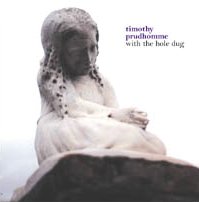
with the hole dug (cover art) Posted by Picasa
DC: Why did you move from Rock to Country?
TP: Do you mean "why did you move from NYC to Tennessee?" I've always enjoyed moving around. And I don't just mean spatially. Change is good; tonic for the soul; and all that bullshit.

DC: What song writers do you admire?
TP: Besides the obvious (Cohen, Dylan, Beatle Boot Boys, Satie), I'm probably the biggest Joey Levine fan in the world. (He's the guy who wrote and sang “Yummy, yummy, yummy", "Chewy Chewy", "Sweeter than Sugar", and a bunch more big hits from the genre of bubblegum. Nowadays, you can thank him for fucking your brain with such ditties as "just for the taste of it...Diet Coke!" or one of my faves… "Come see the softer side of Sears."

DC: You came to song writing fairly late. What made you start? (This question was a mistake resulting from reading too many press releases at once.)
TP: Actually, I started fairly early, when I was about 15 or 16. Though I suppose that that can be considered late compared to Mozart. I got a guitar when I was about 13, but I couldn't figure out how to play anything. Then I read an interview with the Ramones, who said that anyone can play and write good songs if they just put their mind to it. So, I decided to quit trying to figure out other people's songs and just make up my own. And I'm so glad that I came across that interview.

DC: What is up with your bio saying you are dead? For the first time listening to the record I thought you were dead. It made it very poignant. Then I re-read the bio and figured it was a joke.
TP: It's not a joke. I really am dead. Is that funny to you?

Monday, August 08, 2005

Silkworm Interview

Tim Midgett & Andy Cohen
interview conducted via e-mail
by Dan Cohoon & T.W. Walsh
(circa 1997)
Sadly Silkworm is no more. Michael Dahlquist, the drummer for the band, was killed by a woman's failed attempt of killing herself in her car by crashing it into his car at a stop light (she managed to kill Michael and two of his friends who were also in bands). This random, pointless, selfish and senseless act brought an end to one of the finest rock band of the last two decades. Tim Midgett has stated that without Michael there could be no more Silkworm--he could not be replaced.


Silkworm (promo photo) Posted by Picasa
This interview was conducted in 1997 by TW Walsh and myself with Tim Midgett and Andy Cohen from Silkworm via e-mail. Sadly Michael did not participate in the interview. Tim Midgett mentions on several occasions in this interview what a great guy Michael was, and according to everything I have read about him it seems to be true. I have only seen Michael in concert, spoken to him briefly after a show, but I will never forget his big shirtless grin from behind his drum kit. Michael and Silkworm will truly be missed. -Dan Cohoon July 2005

Dan Cohoon: Who are your musical heroes? One of them has to be Neil Young.
TM: I told someone just the other day that Neil Young is one of the only musicians who has had a big influence on all of us in the band, so you are right about that. We really don't think much in terms of other people's music. If we are having a difficult time getting a song to turn out well, we might break it down into "the Rolling Stones part" and "the ZZ Top part," or something, but just as often the guidelines are more like "play it like you're out of your mind on heroin."

DC: Andy's guitar playing is amazing. How did he develop his style?
TM: I am referring this question to him. He should send you a response via e-mail pretty soon.
Andy Cohen: You sent Tim an e-mail asking how I developed my guitar style. The answer is through untold hours of practice. When I started playing back in high school, I would practice sort of obsessively, at least an hour a day, and usually four or so when I had extra time. At that point I had a great thirst to improve, and like all rank beginners, I had a lot of room for improvement. The first couple of years are pivotal for any person learning to play; it is during this time that all your attitudes towards playing and habits form. This period was a good one for my playing. I recognized that I had an emotional impact I wanted to convey through my playing, but that I wasn't yet proficient enough to realize that goal. That realization was my primary motivation for practicing and listening; I could hear that other people such as Neil Young, Hendrix, Sonny Sharrock, Steve Albini, and Bob Mould (at that point in his career) had the ability to make me feel things in their playing that I couldn't yet match in mine.
When we moved to Seattle I had the technical proficiency to attain my goal--the raw ability to move my fingers over wood and wire--but my ability to project complex emotion therewith still lacked. Luckily for me, we spent our first three years or so practicing as a group as much or more as I had previously practiced as an individual. This was the period when I began to put the pieces together and forge my present style, aided by the example of our former guitarist, Joel Phelps. Joel is a great guitarist, which was more evident back then because he played more and more flamboyantly than he does as a solo artist.

At any rate, I know through the experience of playing with, against, and off of Joel, that nothing can make you better faster that playing a lot with a great player. Those were the building blocks of my style. Of course, frequent touring and seeing other good bands always helps me refine what I do, but the learning experience I describe above provides the foundation for these refinements.

DC: How long has Silkworm been together? Were you in any other bands before Silkworm?
TM: I started playing in bands when I was thirteen, but I've only been in three bands that ever played out, including Silkworm. Andy and I started playing together in a basement-only band called Children of Habit, when I was fourteen and Andy a year younger. Andy, Joel Phelps, and I were all in Ein Heit; our first really good band, it started up in 1983 without Andy and I and broke up in 1987.

Silkworm started without me in late 1987. I joined in January 1990, when the three of us moved to Seattle, soon met Michael Dahlquist, and the rest is history. Michael was in a few other bands, the most notable by my reckoning being Dungpump.

DC: Why did you guys move to Seattle? Do you get tired of saying that you're not one of "those" bands?
TM: Seattle is the closest large city to Missoula, Montana. We knew a few people here, and were sort of familiar with it. We knew it was unlikely to eat us alive and that we could make livings pretty easily. Worse than having to tell people we ain't a grunge band is getting fifty or sixty articles and reviews written about us that have as their only point: "Silkworm: from Seattle--and not grunge!" I think that fact is obvious to anyone who sees one of our record covers, much less happens across more than a half-second of our music. I realized the other day that all the "big" Seattle bands are either broken up or barely in existence, and/or doing far worse that they used to do (exc. Kenny G).

DC: How do you guys go about songwriting?
TM: Andy and I write songs individually. Sometimes we bring songs into the band fully arranged, and even more rarely have specific parts for the other two to play. Most often, the material is arranged as a band and often it is dramatically changed. Michael's input, in particular, shouldn't be underestimated. It is a true cliché that bands are only as good as their drummers.


L'ajre (cover art) Posted by Picasa
DC: I love the last two tracks on l'ajre. Are there any plans for a live album?
TM: No. There's not much point in us doing a live record per se, since the way we do things in the studio now is essentially live. Vocals get overdubbed almost always, but it is rare for us to add instrumental tracks over our basic recordings; any such work is done to rectify mistakes that we don’t feel comfortable leaving on the finished track. Also plenty of technical limitations are involved in recording live shows, and we like the flexibility of the studio; recording in a controlled setting allows us to capitalize on the expertise of the engineer with whom we work. I really do like those tracks on l'ajre, though. I think they are the most successful things on that record; we were inexperienced in the studio and doing the songs live made them at once looser and more urgent. A few other unreleased tracks from that live session will likely end up on a compilation of old stuff we are putting together for Matador.

DC: What does l'ajre mean? It took me three years to fail two years of French (let's just say French ain't my strong point).
TM: Don't waste your time looking it up. I long ago checked French, Italian and a few other foreign-to-English dictionaries and the word does not seem to exist.

The full story is: Michael came to practice one day, told us all about this guy he saw walking down Broadway, wearing a beret, little goatee, smoking a cigarette in a holder. This dandy had on a homemade T-shirt with the word “L’ajre" painted on the front. We thought it was a ludicrous example of pretension, so naturally the term ended up as the title of our fist album. We almost called the record our days in ‘nam because we really like the idea of an album so named being released by a bunch of young dorks who were barely out of the womb when the war was on. Often people read satires of pretension as pretension themselves, so it's probably good we didn't do it, though we will be forever stuck with the word l'ajre.

DC: Are there any Silkworm side projects we should know about?
TM: There's a great Ein Heit record in the can. It features all of us, Joel, and two of our mentors who were the founding members of the band. It's a damn shame it's not out yet. With any luck it will be available for public consumption at some future date.


Silkworm (promo photo) Posted by Picasa
Tim Midgett: Laying it down in full view
as interviewed by TW Walsh


TW Walsh: At your show in Boston with Kelly Deal 6000, I interrupted you while you were making some phone calls just to meet you and you were really nice. I definitely appreciate it when bands are nice to their fans. Is that a conscious effort on your part, or are you just great guys?
Tim Midgett: Oh, stop. There are more than a few people I can think of who think we are assholes, so you must have caught me on a good night. Come to think of it, no one dislikes Michael, except his boss, unfortunately.

TW: Tell me a little about Missoula, Montana...
TM: Well, it's a town-city of twenty-some thousand people, not including the outlying areas or the non resident students at the university. It can seem bucolic in spots, but it is warped in many subtle ways, some of them uncommon.

Hard place to describe in a nutshell: full of truck drivers, waitresses, acid casualties, disaffected youth, ex-hippies turned entrepreneurs, all kept there by aggressive inertia and the fact that it is an easy place to bet by. If you saw Blue Velvet, Lumberton has a lot in common with Missoula.

TW: I know that's where Steve Albini's from too. When and where did you meet, and what's your relationship with him like now? Who wins your high-stakes nine ball games?
TM: Met Steve briefly on a couple of occasions during my college years, first recording with him October 1992. We are all big pals now. Steve is a good pool player. He almost always wins, against us anyway. Michael can beat him occasionally; I might have once or twice on lucky shots or if Steve beat himself.

TW: Do you do any recording engineering?
I wouldn't say so. I've helped with the recording and mixing of a couple things not including Silkworm, but my knowledge of the process is mainly on the playing and listening ends: what isn't happening with the playing that needs to happen, or what needs to be changed in the mix to make the recording work. It’s the in-between (read: hard) stuff that I don't know much about.

TW: What do you think of the northeast?
TM: I like it up there pretty well. I've never had much of an affinity for Boston I have to say, though Matt and Tench of Bedhead really like it, so maybe I missed something. New York City is a nice place to visit, not live. Maine reminds me of Montana, so I like it for that reason. I don't know how you put up with all those tolls, All in all, we've seen the entire country more than once, and I'm convinced no place in the US is as impressive all-around as the Northwest (snooty).

TW: What's your relationship with Joel right now?
TM: We don't see each other often. When we do, it is on unfailingly pleasant terms. He's a gentleman and I do my best.

TW: What do you think of his record?
TM: Parts of it are really great. I heard an EP, supposed to be out sometime soon, that is something of a departure for him (piano, horns) and I believe he's making a new record starting the end of this week.

TW: The band has only one publishing company. Did you do this to ensure even royalty splitting?
TM: Regardless of how the money is split up, there is really no need for band members to each have their little individual pub. comp. Some bands do that, but it's more of a territorial issue than anything else. All the publishing money goes back into the band, pretty much.

TW: I heard that Matador is pretty "hands off" when it comes to tours and promotion. I also read an interview where you guys said you were pretty happy with how things were going with the label, but has that changed at all?
TM: I wouldn't say they are hands off when it comes to promotion. They employ many people for the purpose of promoting bands to press, radio, and in record stores. It is true that they don't meddle in their bands' affairs when it isn't necessary, for which all of us are grateful, I'm sure. We are happy with Matador.


Firewater (cover art) Posted by Picasa

Firewater did well; not unbelievably great but far better than any other record we've put out. I think we came to terms long ago with the fact that we aren't likely to ever set the world on fire with our record sales. We work hard, but selling hasn't been a big goal of ours, and Matador seems capable of getting the most that we can out of the records we make.

TW: When is the re-release of l'ajre and his absence is a blessing? What kind of work does this entail?
TM: A bunch of shit work. I don't know when it will come out. I have been telling people late 1997/ early 1998 but last year at this time I was saying late '96. I need to get a hold of all the master tapes, compile them, and go get them mastered. It sounds easy. I say "I need to" because I think the other guys are even less likely to perform those tasks anytime soon. I would like to be able to wave a magic wand and have it all done, but last I checked Billy Corgan has cornered the market on wands designed for that purpose.

TW: The "Slipstream/Inside Out" 7-inch sounds really slick. I haven't been able to get my hands on "l'ajre" and "his absence is a blessing," and I was wondering if they have a similar sound?
TM: Way, though it's even cleaner--interesting that you call our first single slick since a local reviewer thought it had more of a sonically "abysmal" quality. "his absence" was the first thing we did with Steve Albini, so naturally it sounds "noisy."

TW: On the back of the single for "never met a man I didn't like," there's a picture of all three of you guys’ taxi drivers’ licenses. Are you really all cabbies in Seattle?
TM: Andy shit-canned his hack licenses--too scared of getting killed; oddly enough Michael has one and did it for many years, but works a slave temp job at Adobe Software at the moment. I drive three times a week. Too bad I don't have a cell phone number to give all the Boston tourists.

TW: This may sound corny, but you guys definitely have a "timeless" sound. I mean, there are quite a few perfectly valid bands out there (say like Pavement) that just seem to have impermanence to them. Clearly, however, the rock is eternal. Because you play a more "rock" version of rock music, I can see how you might feel a little separated from both popular and underground music. Is this the case?
TM: Most of the music we listen to isn't particularly current. I don't believe in wearing clueless-ness as a badge of honor; I wasn't proud when I tried to think of my favorite albums of 1996 and came up with four--three by bands we know.

It's just that between doing what we do together and trying not to get evicted, and not having (or wanting) a record store job anymore, I don't have the time or energy to wade through the effluvia and dig into the silt to find most of the good music that is out there. It is undoubtedly out there, but there's an extra lot of shit at the moment. The shit is real easy to find. Have to disagree with you about Pavement's "impermanence." Maybe I'm misreading you, but long after Pearl Jam and Smashing Pumpkins have gone the way of Grand Funk Railroad people will be gleaning enjoyment from Pavement records. Also, I don't know what you mean by a more "rock" version of rock music. I think there are distinctions between "rock" and "rock and roll," but I don't know if that's what you are talking about.

Friday, April 22, 2005

Terrastock IV

@ the Show Box (Seattle, Washington)
November, 2000
Photos & Text: Dan Cohoon

I once again find myself on an Amtrak train heading to a city I have never been to before to attend yet another wonderful Terrastock. I roll into the Emerald City, stroll past the strip clubs and the tourist crap of Pike’s Place. The people throwing fish provide a few moments of entertainment. It is all show for the tourist but fun none the less. I stroll down by the water; I can see mountains in the distance and giant cranes in the water.

I head to the venue but it is not open yet. I turn my attention to finding a place to stay to crash. My brother was supposed to hook me up with this Phish taper dude but he had just lost his job and was not in the mood for free loading couch surfers. I locate a rad youth hostel across the street. It is actually clean, (except for the rotting wet clothing smell emanating from the locker below mine). The folk there are friendly. I read previews of the festival in the local papers in the lounge. They have internet that costs a dollar for 12 minutes. It is a racket but it is cheaper than a long distance phone call.

I go to the venue @ the appointed hour, actually well before. I chronically show up way too early to shows. It looks like I am not the only one with that problem. I cannot wait for the show to start. There are few other people in line before me. I wish I had gotten a three day pass so I could get one of those cool badges. I am only attending the last two days of the three day festival. I had just started my gawd awful job @ an awful alarm company. I missed the Friday show because I was in training. I run into Isobel from Bardo Pond outside the club. We exchange hellos.


Major Stars (photo: Dan Cohoon) Posted by Hello
The doors swing wide & I enter the glorious Show Box. It is an old club. It probably hosted a couple of old school Psych shows back in the 1960s. It is beautiful inside. They have a groovy light show going and two stages of music. The first band to play is the always wonderful Major Stars. For the first time I moved out to the west coast I am homesick for Boston. Many a Saturday I wasted in Twisted Village, in Harvard Square lusting after records I could never afford. I remember it was always great when I saw Wayne & Kate trotting around the square eating ice cream cones. Major Stars are so unbelievably heavy. The heaviness of their music is only matched by their awesome beauty.

I skip out after their set and get the most unremarkable Mexican food at the place next door (really it was sub-par Taco Bell). I head back to the club. Martyn Bates from Eyeless in Gaza does a pleasant acoustic set. Sub Arachnoid Space has a singer that looks like he stepped directly out of a Mother Goose book (he had the librarian specs on a string & a crazy hat). The evening really started rolling when Linus Pauling Quartet hit the stage. They take the best parts of Sabbath & combine them with the greatness of space rock. The high point of the first night of the fest is "Hall of Mirrors."

So it is @ this juncture in the evening that my memory gets a tiny bit fuzzy (heh, heh). Kate from Magic hour/ Major Stars said of the Deep Heaven events much like the decade known as the sixties, if you can remember them you were not really there. I do recall that I truly did enjoy the set by the Green Pajamas but I can't quite remember why. Perhaps it is that they just fucking rock.


Moe Tucker (photo: Dan Cohoon)Posted by Hello
Next up, the two least annoying members of the Velvet Underground play (Doug Yule & Moe Tucker). Doug Yules take of “Beginning to See the Light” had John Gibbons (Bardo Pond) humming it for the rest of the evening. My favorite moment was when Doug & Moe sang “I’m Sticking With You.” I know it's a really silly song but it always has held a special place in my heart.

John of Bardo Pond asks if I want to go hang out at the hotel where all the bands are staying. I say sure. Out on the street I buy a soft pretzel, a purchase I instantly regret. Maybe I have been away from Philly too long or maybe soft pretzels just in general suck. I pawn it off on the kids from Bardo who gladly devour it.

We stroll down the street in the chilly November night past smacked out heroin addicts lying in their own puke. On the hotel room's balcony Mike Gibbons pulls off a feat most admirable. The room is on the second floor. Some one shouts up from below, "Hey you guys want a beer?" The obvious answer is, "Yeah!" The voice below says, "Let me open it for you." Next an open tall boy comes sailing through the air; Mike catches it one hand and only spills a little bit. Such a feat of physical dexterity and artistry I have yet to witness since.


Clint & Isobel of Bardo Pond (photo: Dan Cohoon) Posted by Hello
After hanging out in Bardo's room for a bit, we head over to Abunai!/ Lothar's room. They have an impromptu jam session going on. Mike tells me of the fabled "brain machine." It is basically goggles that have lights that project into the wearer's eye. I do not get to check it out but I bore witness to someone who was under its spell.

We once again return to Bardo Pond's room where they watch golf (sorry to ruin your street cred guys). That is a little too crazy for me so I head back to the hostel. I stroll down the deserted streets glad that I have at least a bed to sleep on tonight. I did not for the first Terrastock. A night on the cold streets is something I do not want to repeat.
The next morn it is raining. I awake at seven (I went to bed @ 3:00 am, I think). I stroll around looking for coffee. I get some. I head over to Experience Music Project. I see the monorail A more useless form of public transportation I have not witnessed. The EMP building is as ugly as I heard. I do not go in the museum itself. it is insanely expensive. I do have fun in the gift shop playing this guitar with all these weird effects.

I go over to Pike’s Place for lunch. I get some seafood. I have not had any good seafood since I moved from Maine. It is weird I have been away from New England for a year (at the time of the fest) and this week end is the first time I truly got lonesome for it. In the afternoon I head to the art museum. There is a big exhibit of Pop Art going on. While not my favorite style it is interesting to see paintings I have seen in slides in person. The actual object is always less than pristine, which is beautiful. I think the museum is where I lose my bank card. I do not realize it until later on in the day. There is a music store across the street from the show box; I spend the afternoon playing crazy-ass percussion instrument (much to the delight of the store clerk I am sure).


Six Organs of Admittance (photo: Dan Cohoon) Posted by Hello
On the last night of the event the first great performance of the night is Six Organs of Admittance. It is a beautiful and cathartic show. The home boys & gal from Kinski played next. They I think are one of the better bands on the west coast; most certainly the best band to come out of Seattle. (It is so fucked up; the press in the NW is still hung up on all that crappy west coast grunge shit). I always find Kinski shows therapeutic. The volume & pure mass of their tunes really clear the head. I always feel ten times better leaving a Kinski show than I felt going in. This is my first time seeing these guys & since then I have seen them at least five times since.


Chris from Kinski (photo: Dan Cohoon)Posted by Hello
Bardo Pond's set is great. It is the first time I see any of the material from Dilate performed live. That record is a dramatic change for the band. Live it changes their show. There is now breathing space in the set where as before it was one wall of massive beautiful gunk.

Next up was the beautiful mythic Children of the Rainbow, a "legendary psych band," who had just returned from Hawaii. Actually it is Magic Hour reunited with the addition of Isobel (the only one who did not need a blond wig) from Bardo Pond. What was to be a joke turns out to be not a bad set.

The evening ends with the Frond Fish playing (Bevis Frond & Country Joe MacDonald). Some really genuine hippies turn out to see Country Joe & the Fish, which amuses all the self-aware space rock hippies. The weekend was full of peace & love. No I am not being a smart ass. There is genuine open heartedness & kindness between everyone involved. The fest could not have ended more perfectly as when I walk out the door and Clint Takeda & Ed Farnsworth (Bardo Pond) both give me high fives.

Links:
Ptolemaic Terrascope
Terrascope U.K.
Terrastock IV

Monday, April 04, 2005

Shipping News Interview

RMSN interview with Jason Nobel & Kyle Crabtree
@ the Pine Street Theater circa 2001
interview & photos by Dan Cohoon


Jason Nobel of RMSN, PDX, 2001 (photo Dan Cohoon)Posted by Hello
The last two years of high school I listened to Rodan’s Rusty twice a day. They were by far my favorite band back then. When Rodan broke up I was really devastated. In college I followed Jason’s group Rachel’s religiously. While I loved the Rachel’s I longed for the return to the rock. When Shipping News’ Save Everything came out it was all I was hoping for and more. This interview was conducted while the Shipping News was touring in support of Very Soon & in Pleasant Company. It is a great honor to meet one of my musical hero’s of my misspent youth. What was even better is that he was actually a real genuine and down to earth person as well. –Dan Cohoon (2001)

Dan Cohoon: When did Rodan come about?
Jason Noble: We started very early in 1992 after Jeff and I were working on other musical projects. We were living in a house with people in the band Crane. We knew Tara really well. So John Cook was who was the bass player and singer; he ended up playing drums and bass guitar in the band Crane. He was our first drummer. The three of us started playing a whole lot together. I guess Jeff, Tara and I started writing more and John started playing more. We started to go play out of town. We played our first show in July of 1992. We did some recordings at a place called the Hat Factory, which was the place where Jeff and I worked on a couple of different things. We had done one of the recordings for Rachel's. We were friends with this guy that we knew from Baltimore. We went up there and John, Tara, and I recorded our first collected group of songs with our friends from Simple Machines. From there we started going out playing and touring, having our first real experience of a traveling working band. Then John Weiss started playing with us in January of 1993 and then Kevin joined us eight months after that. He was the one and traveled for the longest part of touring we did with the band.

DC: So Rachel's came before Rodan?
JN: It was purely project stuff. It was just something Christian Fredrickson and I did while we were living in Baltimore. Rachel's wasn't a band it was just something we enjoyed doing.

DC: Are any of the recordings from that period on Handwriting?
JN: One of the things from 1991 is on the first record. There is some other stuff from 1993 right in the center of doing Rodan stuff. Rodan was a full time project; we would practice a lot every week. With Rachel's a lot of the time we were in different cities. It was just a different process.

DC: So why did Rodan break up?
(Kyle from Shipping News walks up as I ask the question.)
JN: He just asked me an infamous question. He asked why Rodan broke up. I've got a good answer. This isn't the pat answer. We broke up so that we could stay friends, so that we could explore different things. We were pretty hyper people. We are hyper people still. We just wanted to try a lot of different things that weren't all the same things. So instead of making Rodan into several different bands we just made different bands. It is a little self evident how everyone just did different things. I think that it was real positive for us as people. We're all still friends so I guess it worked. It wasn't this fiery insane thing. Something ending that you really care about is always emotional. It wasn't like I'm never going to talk to you again. . . . It was Kyle's fault. Kyle broke the band up.
Kyle Crabtree: I used to be a woman.
JN: Used to be?
KC: I got in-between everybody.

DC: It seems that a lot of the music of the late 1990s was a reaction against the loud bombastic stuff of the early 1990s. It became more punk rock (in the early 1990s sense of the word before it became a narrowly defined sub-genre) to make pretty music.
JN: There is a kind of challenge not to play music that is anticipated in the environment; the venue is accustomed to this really bombastic heavy ferocious music. We are going to ask for people to have some patience with us. We are not going to demand your attention; we are going to ask for it. It wasn't a conscious movement. There was so much rock music out side of the actually independent music world that was sort of bombarding every one. We needed to carve our own way from this. If that means drawing on Neil Young or Philip Glass that's ok because those people are as punk rock as Big Black or Sonic Youth.

DC: Do you think geography has an effect on musical styles?
JN: I can't imagine that our environment doesn't change what we make or what we produce. The type of bands and type of atmosphere in Louisville are pretty conducive to having some mental space to make music and there are a lot of people to play shows with. It was a pretty energetic time, and it still is. Not even scratching the surface of all the music in the world that is directly related to the culture it comes from. Gamelan music is something that you cannot remove from Indonesian society. Well, some of the music that comes from Louisville, although it might not have quite the historical tenure as those things, is part of it. The bands you see when you're forming your musical ideas and the interest kind of piqued by seeing bands in your own town. They are all trying something different because there is not one scene. It is not one big city that has one big band. There are lots of bands.


Jeff Mueller & Jason Noble of RMSN (photo Dan Cohoon) Posted by Hello
DC: What is up with all the nautical imagery?
JN: I think that is very surface. There are five June of 44 records; very few of them have sincere nautical things about them. There is one Rachel's record of five and the Shipping News has a name that is related to it. The Shipping News knew that we were going to get nailed for that. We did it almost knowing that . . .
KC: Kind of like a joke that doesn't translate all that often.
JN: The whole concept of what the two words in shipping news...we just like the connotations of it and it is kind of archaic in a way, and sort of older technology. It's really less premeditated than it seems. The culture in Louisville is a river culture. The city is there because of the river. After the fact I started finding out about the history of the town. The main hub that became Louisville became Shipping's Port, where the falls of the Ohio were impassable so people started trading and staying. It is in the culture there. It would be just as much to say that we would make songs about tobacco and horses and bourbon and basket ball. Luckily for people, we did not do five or ten years of basketball records because I think Kurtis Blow pretty much nailed it... He said what needed to be said on the subject. It is just a romantic ideology. It is an antiquated aesthetic. We like old things. We like dirty creaky, rotten looking things.

DC: Are you going to have films?
JN: That is only with Rachel's. Kyle does sort of an interpretive dance. Some times he gets shy and won't do it. Some nights he is on fire. That is the only visual part of the show.
KC: I do an eleven finger hand jive.
JN: It is called legend of the eleventh finger. You can just imagine what that might entail. The nautical stuff is part of a lot of things that we find interesting. It captures our imagination. It is fun to draw on history. Even if it seems like were being a little myopic.

DC: What band were you in before shipping news? What instruments do you play? (to Kyle)
KC: I've played different bands around Louisville. The most recent before shipping news was Eleven Eleven. I play drums, I play guitar too.
JN: He played in Metroschifter, Rachel's toured with Metroschifter. All the bands played together, it's that kind of town.

DC: I really like the "Quiet Victories" song off the last record. It could very easily come off as preachy but it doesn't. It really works well the way it is understated.... because there are a lot of bad folk singers out there...
JN: (laughs) Bad Folk singers?

DC: That sing about the same thing. It seems kind of insincere when they do it, maybe not insincere but....
KC: It kind of doesn't hit.

DC: It doesn't have the emotional impact, I guess, is what I am trying to say. That is a quasi-political song. Are there any songs in the past that are political?
KC: I think that song is as much subject and story. I think you're right when you call it quasi-political and also a tribute to other music. Jason wrote the music so he would be better to answer it. For what our band is in reference to a question like the input of political ideas things like that, it is definitely not like that. If there is something to be said through some piece of history that has story with some impact or tragedy, there are lots of sort of tragic elements to our music. That song fits in for most into that way of thinking about it then to say that there is some ultimate political structure behind those ideas.

DC: Is that song based on an actual event?
JN: Unfortunately, that song is based on lots of actual events that are readily available to read about; it is really just a colonial mind set. And just you know people who are unscrupulous who come in and take...
KC: ....Put other people down. That song in my mind can be related to injustice of many kinds, from person to person... society to society.
JN: There's been political content in things that we have done. We've always poked at it. It is a real difficult thing to include and it not be trite. Stuff like that we write on our web site or have printed over the years; we definitely try to think of our selves as involved with those subjects. There are some of things in my life that can be easily contradicted; the ideals... I want to strive towards a point of morality. When you get into singing about things the fear is that it would come across preachy.... 'well what are you doing about it?' 'What is your answer?' The only answer in that particular song is not some grand scheme. It's really just that the small things can survive. That is a hard thing to even summarize. Luckily, the way we approached that song was talking about a relation ship. It was just about...

DKC: The two people
JN: We approach everything on a person to person level. That is the only frame of reference that I have. I just respond to that kind of song writing. That song is definitely not some original concept. There are other songs about… there is "Cortez the Killer" There are a million people who have written about it... Even in a weird way some of the things that we fixated on like the whole beautiful element of the ship; the romantic idealized version of it. Our world is a product of these people going everywhere. The modern world is a product of this power struggle. It is hard not to want to talk about it. The power struggle applies to a relationship song. You are trying to do what is right and things get fucked up.

Links:
Royal Majesty Shipping News
Rachel's
Rodan

Sunday, March 27, 2005

Dunedin--It's All Right Here

Photos & Text by Jim Ebenhoh

I could never figure out what the hell that saying meant, but it was the official slogan for this city of 100,000 on the southeastern coast of the South Island of New Zealand. I think my slogan for the place during my few years there was maybe a little less subtle; something like Dunedin--Beautiful City with Damn Good Music. And a lot of it too. Mind you, New Zealand as whole, for only having 3.5 million people compared to 50 million sheep, managed to produce a great lot of bands since about 1980. There were a lot of great non-Dunedin bands, like the Gordons-then-Bailter Space from Christchurch, and Jean Paul Sartre Experience, Headless Chickens and Able Tasmans from Auckland. But Dunedin was really always where it was at.


Tall Dwarfs (Chris Knox and Alec Bathgate) at the University of Otago 1995 Posted by Hello

I guess the part of it that I'm interested in began in the late 70s when Chris Knox and his buddies in The Enemy shaved their heads and began their own crazed punk show while students or dole-bludgers loosely affiliated with the University of Otago. They inspired countless other scarfies, such as Graeme Downes and his Verlaines, and Otago Polytechnic students such as The Clean, to trade in their schoolboy uniforms for electric guitars and Velvet Underground-inspired KiwiRock. Martin Phillips turned his 16-year-old poetry into hits for The Chills, Shayne Carter skated down from the public housing ghetto of Brockville to lead the teen band Bored Games for a wee while, The Stones did their version of surf-rock, and Sneaky Feelings put together some slick melodies.

It all picked up momentum when Roger Shepard began his Flying Nun label in Christchurch with The Clean's epic "Tally Ho" single in 1981 and followed it with the Dunedin Double LP in 1982 featuring the Chills, the Verlaines, the Stones and Sneaky Feelings. Over the course of the 80's many more bands put out some amazing music on the Flying Nun label, most of them from Dunedin. Something about the cold rainy winters and the lack of central heating inspiring young Dunedinites to slice their fingers across the strings just in hopes of cutting through the chill. That and the fact that college was free in those days and supplemented with a living stipend sufficient to maintain a diet of Vegemite and toast, leading college students not to take school all that seriously and to have a little spare cash to buy a used amp and let it rip. The Verlaines and Chills carried on through the 80s, the Clean disbanded but the Kilgour brothers kept going as the Great Unwashed and Robert Scott started the Bats, the all-female Look Blue Go Purple did some great stuff, and Shayne Carter moved on to the amazing Doublehappys and then on to lead Straitjacket Fits after another Doublehappy was killed while taking in the scenery on a train ride back to Dunedin.

The 90s brought some major label deals for many of these bands, only to see the Chills and Straitjacket Fits break up under the strain of the U.S. business and the Verlaines also dumped by their fickle American major label. Meanwhile, a new movement was emerging out of the salty harbour town of Port Chalmers, just a few miles from Dunedin. Bands like the 3Ds and the Dead C, and individuals like Alastair Galbraith and Peter Jefferies, were recording themselves at Fish Street Studios (what a name) and distributing cassettes to groups of friends under the guise of the Xpressway label. They eventually pressed some vinyl, and some of it eventually made its way halfway round the world to Boston-area college radio stations like WHRB and WMBR, where young hipsters who were groomed on the Flying Nun sound chipped their teeth on the new sounds.

I guess I was one of these young hipsters, and I recall the intense gleeful stupefaction that overcame me when I put the Peter Jefferies/Robbie Muir 7" "Catapult/The Fate of the Human Carbine" on the turntable in 1991. I had gotten into the classic Dunedin jangle of the Chills, the Clean and the Bats in the previous year, but the whole Xpressway thing was something else. Moody, murky, out there, but intensely beautiful. And somehow managing to evoke the salty fishy foggy splendour of the surroundings I imagined. The 3Ds were more rock-based, but quirky and pleasantly "not right." I was able to interview the 3Ds at WHRB in 1992 and found David Mitchell and Denise Roughan to be downright frightened at the fervor with which we recalled all their past releases. I don't think they had really imagined how unique they were in the swamp of Nirvana clones that most of "college rock" was mired in at that time.

A friend of mine spent his junior year studying at the University of Otago in Dunedin and came back with a big fucking cheese-eating grin on his face. He was just giddy. He didn't have to say anything. I vowed to go to Dunedin. I took the next year off, and somehow spent too long on Maui and got stuck in a snowstorm in the Oklahoma panhandle and ran out of money and time, so I didn't make it to New Zealand in 1992. But the next year I applied for a Rotary Scholarship, got it, and had to wait a year to graduate, then a half-year for the NZ school year to start before I headed there in early 1995. In the meantime I saw an amazing show at the MiddleEast, the "NoisyLand" show with Straitjacket Fits, the Bats, and JPS Experience. The Bats were especially amazing, though hearing “She Speeds” by the Fits and “Flex” by JPSE was a real highlight too. I also saw a completely robotic and demonic Bailter Space at a particularly crucial juncture for my mental well-being. You know, one of those shows where the music is so good you think you're going off the deep end, but you go home that night feeling on a more even keel than you've felt in months. Brought me full-circle, those KiwiBots.


Dimmer (Shayne Carter) at the University of Otago 1995 Posted by Hello

Anyway, I spent a year studying in Dunedin in 1995, but it wasn't really about the classes I was taking (city planning with a bunch of rugbyhead surveying majors). It wasn't really about the University too much, although I did a show at their great Radio One and couldn't help imagining Graeme Downes slinking around as an undergrad, smoking too much and trying to fit too many million-dollar phrases into a three-minute rock song. It was really about Dunedin, which for me was an entanglement of gorgeous hills and shimmering waters surrounding a town of dank but beautiful Edwardian villas, totally entertwined with this sense of history that wasn't so much the Scotch and haggis the civic leaders touted but the feeling of immense importance as a source of some of the best music I'd ever heard. I know that sounds lame but it all just clicked the day I came to Dunedin.

It ended up being mostly a sense of history, as the real heyday of Dunedin bands was in the '80s and even the Xpressway scene was petering out by '95. Peter Jefferies moved to Canada with his Mecca Normal femme in '96, and Martin Phillips, David Kilgour, Shayne Carter, and Graeme Downes temporarily left for northern climes. But I bought some great music for way too cheap. I saw a lot of bands. And I had my own brushes with musical greatness.

First the bands: my first weekend in town I went to see the Dead C, a Handful of Dust, and Gate at this crazy old seafarers' pub called the Wharf Hotel. About 20 people there, all smelling of patchouli and handrolled cigs. Especially Alastair Galbraith. Mindblowing show, and the only time the Dead C played live during the 2-1/2 years I was there. Then was Orientation, this big booze-n-rock fest at the beginning of every school year at the University. Thirty bucks for the whole week. In one week I saw the Verlaines, Tall Dwarfs, King Loser, 3Ds, the Renderers, and Dimmer (Shayne Carter's semi-solo outing). That first year I also managed to see the Magick Heads (Robert Scott of the Bats' new band) several times, a solo Peter Jefferies show, a great 3Ds show where they did a cover of Guided by Voices' "Tractor Rape Chain" (I was too drunk to believe it at the time), and David Kilgour and Martin Phillips as the April Fools. I also DJ'ed around a live-to-air Radio One gig by Alastair Galbraith which was haunting and beautiful. Interviewing him over the air, I was told that not only was Dunedin a factor in his music, it was "essential." Or maybe it was "fucking essential." That would have been a better quote.

After a few miserable months back in Ohio in early '96 I returned to my fiancee Kelly and Dunedin. We caught the Able Tasmans' last gig, the Look Blue Go Purple one-time reunion gig, a "Portstock" at the Port Chalmers Town Hall, and more than a few great Verlaines gigs at the Empire. Which is the best bar in the world, owned until recently by the married rock-star couple that is one-half of Chug, and featuring some bloody good organic New Zealand beer on tap. But I digress. Another highlight though not a "gig" was the Otago Settlers' Museum exhibition on 30 years of Dunedin popular music, featuring Chris Knox's famous 4-track (on which everything in NZ between 1980 and 1984 was recorded) sitting unassumingly in a glass case. As I sit here listening to the Clean's "Getting Older" I have to wonder if I should have been more depressed seeing a museum exhibition on the heyday of Dunedin rock than I was at the time.

The whole time I was in Dunedin only a few American bands made it down our way. One was Sebadoh. Lou Barlow told the crowd what a beautiful city Dunedin was and how his apartment in Boston sucked because there were always trucks backing up in front of it, and I felt kinda weird at knowing exactly what he meant. Barbara Manning also came by, as did Portastatic. And I think Fugazi did a show but I didn't go.


Peter Jefferies at the Empire 1995Posted by Hello
So now the stories, gossip, dirt. Well, Kelly and I went to an art school ball at a Tex-Mex restaurant and ended up dancing next to (rather, trying to not get in the way of) a cheerful swingin' Alastair Galbraith and his accompaniment. During my first year in Dunedin Alastair was reputed to be living in the shed of a friend of a friend, but the conditions proved to be somewhat unhealthy and that arrangement ended. Another night Kelly and I were standing around our living room after a party when Robert Scott walked in and asked "Is Shayne here?" I suggested that Shayne might be at the party next door, and proceeded to blather on about what a great gig Bob had done at the "Neil Young Nite" a couple days ago at the Empire, poignantly punctuated at the end when I bleated "Bye, Robert...." as he disappeared into the night. I think I came across as a geek. Kelly took the cake for her brush with fame when she plowed into Shayne Carter on her way to the bathroom at the Dunedin Musician's Club after a few too many jugs of Speights ("The Pride of the South"). A distraught Shayne sneered in his classic drawl, "Waaaatch ooooouuuuutt!!!" We had a good laugh about that one.

I left in the middle of '97 with Kelly to go back to school in Beantown, and it's hard to believe now that I spent nearly 2-1/2 years there. There's a lot else about Dunedin I could tell you, about the crazy sandwiches with eggs and shredded carrots, the gorgeous handknitted secondhand one-dollar wool cardigans at the Red Cross, the dubious fish and chips, the braindead rugbyheads, or the stupendous walks in the Town Belt. But this is a 'zine and 'zines are all about music, or at least that's what I've heard. I guess all I can say is Dunedin is a pretty amazing place even without the music. If you can score a Rotary Scholarship or some other way of paying the steep plane fare, don't even think twice about it.
-Jim Ebenhoh
Copyright 1998, 2005

Friday, February 25, 2005

John Fahey Tribute


John Fahey's Last Concert Posted by Hello
Photo by Dan Cohoon of John Fahey's last concert
@ the Viscount Ballroom (Portland, Oregon)
November 8th, 2000


Our friend John Fahey died on February 22, 2001 in Salem, Oregon of complications from open heart surgery. He was a week short of his 62nd birthday. Below are some thoughts I penned shortly after hearing of his death.
-LEE RANALDO

I'm in Japan right now. We heard about John's death the morning it happened. Between Jim O'Rourke, Thurston and myself, we had many ties to him. I've been a huge fan of his playing since way back, discovering his first albums on Takoma and like music such as Leo Kottke's first great LP, which John issued. These records, the stylistic adventurousness inside of what seemed a traditional genre, influenced me greatly, with their open tunings, extrapolations, and found-sound additions. Meeting and spending time with John was a further treat. We did a small amount of touring together a few years back and— sadly— were just recently talking about trying to record some acoustic duet music together. He was a great big bear of a man who had a strong head and went his own way, a determined combination of confused and focused, it sometimes seemed. Reading the pieces in his book, "How Bluegrass Music Destroyed My Life", further emphasized both his scholarly nature and his sense of fun, his good humor.

John also passed to friends these last bunch of years some of his visual art which is quite good and takes many forms from artful scribbles to more sophisticated brushwork. I don't think many know that side of the man. He recently sent me a group of drawings on the theme of the Coelacanth, an ancient fish from prehistoric times that survived into the modern era. It's something we were talking about whilst touring together—and it didn't strike me at the time but maybe John felt an affinity with this creature? Seems likely.

Most of all, of course, it's the music he made, in all its forms, which will live on to inspire us for a long time to come. John was an uncompromising individualist who lived a life of his own, sometimes strange, choices. The music on the other hand is never strange, always almost pure and perfect, rising above any earthly predicaments, soaring up into the heavens. His recent electric guitar workouts, on the one hand so far from his best known acoustic music, further proved his willingness to expand the focus of his music.

When we toured together I was constantly amazed at his patient capacity to sit and coax one sweet electric note after another from his guitar, giving each its own breathing space, connecting the dots of a melody known only to him. Our song NYC Ghosts & Flowers is, in part, about memory and the loss of loved ones (as well as the birth of new visions)—I've been dedicating it nightly to John over here in Japan since the morning we heard he died….
-LEE RANALDO 02/24/01

Links:
John Fahey
Lee Ranaldo

Tuesday, February 22, 2005

David Grubbs Interview


David Grubbs (photo: Dan Cohoon) Posted by Hello
David Grubbs interviewed @ T.T. the Bears 1999 by John Cohoon
Photos by Dan Cohoon @ The Middle East 1997
(Cambridge, MA)

John Cohoon: What is your history of your projects?
David Grubbs: I was in a band called Squirrel Bait that put out a couple of records, those were my teenage years. That was my high school band. I was in a new wave band before that called the Happy Cadavers. Whose single just sold for four dollars on E-Bay (laughs). A completely terrible record. I ran into some one from Washington DC. who said ‘“what are you going to do when some one puts out the Happy Cadavers on MP3? It’s bound to happen. What can I do? I grew up in Louisville, went to college in Washington DC. Moved to Chicago in 1990 to go to graduate school. I just moved to Brooklyn, New York a couple of months ago.

JC: How did Gastr Del Sol come about?
DG: Gastr Del Sol came out of Bastro when I was on hiatus. I had taken a semester off from grad school. I was touring. It look like it was stagnation time again. There was general dissent. I thought maybe this should reconvene under different circumstances and it did. It started with Bundy Brown & my self. John McIntyre got back in the picture and Jim O’Rourke did. The remainder of Gastr Del Sol was mainly Jim and I and whomever clamped on.

JC: Thorough out the whole thing have you always done solo things?
DG: NO I never really played (solo) ...except for very strange sporadic things. The first time I did it on tour was when Gastr Del Sol was supposed to go on tour with the Red Krayola 3 or four years ago. Jim decided at the last minute that he wasn’t going to do that. That was when we were still working on Camefluer. So the show must go on. That is the first time I did that.

JC: How did you hook up with Jim?
DG: Chicago is not such a large town. You’re bound to run into people. I had heard a couple of his records by Jim like Tamper & Remove the Need, which I liked a whole lot. We just had a couple of friends in common. It was inevitable that we would meet. and given our personalities it was also inevitable that we would work together.

Upgrade & Afterlife (cover art) Posted by Picasa
JC: Most of your stuff is on Drag City. Do you do stuff for other lables?
DG: The first solo record that I did was for Table of the Elements, called Banana, Cabbage, Potato, Lettuce, Orange. In general Drag City is my home. That is where my e-mail account is , it’s where the royalty checks come from. I have a lot of friends who are making interesting labels. I like to do things for them. Rectangle is a label from Paris. I made a record called Cox Comb for them. It came out six months ago. Albert Erlin who was in the Red Krayola does a label. I just did something for a compilation for him. Conversely he just did a record for my record label which is called Blue Chopsticks which DRAG CITY is manufacturing.

JC: Where did you study?
DG: Georgetown under grad, University of Chicago grad, I am still technically still a student at the University of Chicago.

JC: Is your solo work taking on a new direction?
DG: (laughs).....From?

JC: GASTR DEL SOL.
DG: The working process is completely different. The end result is not as severely different as the working process. It is hard to say. I am smack dab in the middle of a record right now that I have been working on in Brooklyn. I can’t tell you how it is going to turn out. It will sound like a full band. John Mc Entire is playing drums on it. It won’t be so similar to what you’ll see tonight which is the solo guitar....If that gives you any clues into the working process..... I have to be dirty up to my elbows before I know what I am doing.

JC: Do you do allot of home recording before you go into the studio? Who have you been recorded or produced by?
DG: Jim did most of the engineering on the Gastr Records. Phil did the last couple of records. He died of an aneurysm six months ago. Which is incredibly sad, a really incredibly sweet person. I have never had a producer for a record. I have never really seen the need for one. I guess you would say that all the records I have done have been either self produced or co-produced with people in the groups. That seems like an unnecessary designation. I can’t see the function of a producer as being so separate from an instrumentalist or a writer. I would really enjoy producing other people’s records. I know other people like to come in with skeletons of songs and have other people flesh them out. Jim does that all the time for people’s records. That is a little of what we did with Stephen Prina. We made arecord for Drag City that Jim and I produced. Stephen just came in with tapes of things. We just sat down and hammered it out in a couple of weeks. I enjoyed that. I enjoyed that process of collaboration very much. Forwhatever reason I haven’t found it necessary for my self. I can’t imagine what a producer would do if I were to hire one. I think he would have a bunch of suggestions and I would be like....uh...No (laughs)

JC: Do you see yourself doing more of that kind of thing with your new label?
DG: The new label is super low budget. It is mainly reissues or records that people have made at home. I can’t imagine getting people to record for the label then producing them. It is not like Phil Specter starting a record label.

JC: Do you think home recording has strong benefits?
DG: Oh yeah, vastly, vastly. I primarily make records in studios. Don’t think I don’t kick myself all the time for not taking the reins more fully.

JC: Did you start out making records in studios?
DG: Yeah, as a teenager.

JC: You never put out four track tapes?
DG: I’ll put out the odd thing that I just recorded at home on a DAT machine.


David Grubbs @ The Middle East (photo: Dan Cohoon) Posted by Hello
JC: Do you have a home studio?
DG: I have a computer and I have the software; I ditz around with that some. Some parts of the new record will be assembled on that. The new record is all acoustic recordings. Guitar, drum kit, piano, stuff like that.

JC: What is your musical background?
DG: Classical piano, but you wouldn’t be able to tell. I should have practiced more.

JC: What would you be interested in doing in the future?
DG: I would like to write more. I was in grad school so I was writing papers. I have kind of fell away from that. I taught at the Art Institute of Chicago for a couple of years. I just moved to New York and my only job now is making records and touring... Just for the sheer fact that I am saying this in an interview maybe I am obliging myself to follow through but I would like to return to writing. I would like to write about music. I have been kind of shy about it.... Oh I would get bored doing one thing or the other. I think there is some truth inthat. I think I should just bite the bullet and start writing about music more. I have always felt that I had to keep these things separate. I make music and write about this other thing. It’s putting my cards on the table to early. There are so many things that are killed by explaining. I am a person who likes to write, likes to read and believes strongly in the power of explanation. I always felt that if I blabbed in writing about things I feel strongly about in terms of music, that would some how de-mystify the records I make. Okay I have given it way now. Clearly this is not the case.

JC: How important are lyrics to you?
DG: For me very important. I assume that with most people they are lessimportant than they are to me. Then there is the occasional weirdo who attaches allot of importance to it. For me it is an integral part of the puzzle on how to make a record. It would be very easy for me to write poetry and make instrumental records. Nobody would get there toes stepped upon. It would be very easy to keep them separate. But one of the challenges and one of the rewarding things is to do these things together.

JC: Is that important the marriage of lyrics and music?
DG: Sure but it is so hard to do. Singing is the least natural thing in the world to do as far as I am concerned. Some people just open there mouths and sing, but I don’t know. I write things on the guitar and think how in the world am I going to sing to this.

JC: Is that something you have gotten more comfortable with?
DG: Yeah I have gotten more comfortable and natural in the actual execution ofit. I am speaking to someone who is in the midst of writing a record. They have nearly all the music for the record written and most of the lyrics. One is on tape. One is in the note book. I haven’t fit these things together at all.

JC: So they start as completely separate entities? Are they fully developed before?
DG: OH yeah pretty much. (laughs)

JC: It seems like allot of your records are done at the same time as the music.
DG: No, No very separate. For me it is fairly possible for me to go into the studio and record an entire record and then still be tinkering with the lyrics.

Links:
Drag City
David Grubbs
Blue Chopsticks

Bugskull Interview


Sean Byrne (photo: Dan Cohoon) Posted by Hello
Sean Byrne interviewed @ Laurelhurst Park
Portland, Oregon (Fall of 1999) by Dan Cohoon
DC: What is the history of Bugskull?
SB: It started out in 1991 with me just recording stuff on a cassette four track. I put together a tape that Shrimper put out. James played a little on that. I got a drum set for James and Brendan joined the band.

DC: Was that the tape with the long piano piece on one side? What was the name of that?
SB: Subversives in the Midst. We had another name for that called Musk Grove Complex.

DKC: Who is in the band?
SB: When we were a band unit that performed and practiced it was me and James and Brendan.
DKC: What do you think of Lo-Fi as an aesthetic choice as opposed to something you do out of necessity?
SB: (pause) I think that is a good question. (laughs) I think a lot of people misinterpret what lo-fi was all about. Everyone thought that it was about people deciding to make things sound a certain way. I think people were using the only resources they had. I think it was more of an economic movement then an artistic movement. (pause) What do you think of that?

DC: I always loved lo-fi. I love the sound of lo-fi. I kind of miss it when bands get more resources and are able to record at a higher sound quality. The new Sebadoh record is just not the same.
SB: It creates a different way of working. This changes what the way you create. In one circumstance you can create at home when ever you want. When you go into a studio you all ready have to be prepared. You are not allowed to be as spontaneous.

DC: You write both songs and do a sound piece is there a difference between the two or how you go about making them?
SB: No, it depends on the situation. The sound pieces all come out of recording. Some times I write songs before I record. Sometimes I will be recording a sound piece, after I got the ambiance there, I then write a song over the top of that. Creating a space first then putting a song in.

DKC: What kind of music did you grow up listening to or what did your parents listen to.
SB: My parents didn't listen to music that much they used to have Kingston Trio records and Joan Biaez. But they really didn't listen to them all that much, thankfully. My Mom would always have KEX which would play seventies easy listening music like the Rose and Neil Diamond. That is what I heard most. Then I got into Heavy Metal (because of my older brother). Van Halen pretty big, Ozzy Osborne, Judas Priest, and Pink Floyd. I got really into Pink Floyd... Then I got into Classic Rock, Jimmy Hendrix, when I heard him he was my hero. I got into the Meat Puppets when I was 14. That was a pretty big influence on me. His guitar playing is incredible. Its been evolving, It seems like its constantly changing. Now I get mostly Jazz records and weird ambient stuff. I have gotten into Gil Evans. He did the Miles Davis record Sketches of Spain He arranged the whole thing. He does real cool stuff like real spacey totally different than most jazz.

DC: When you're creating music are you thinking about a particular response of the listener?
SB: I guess so mean when I am creating it, I am the listener. So I guess I am looking for a response from myself. Hopefully that will translate to other people. I try to make something that I will want to listen to later. After I make something I cannot really step away from the creation of it and to be able to listen to it as a completely separate thing.


Phantasies & Senseitions (cover art) Posted by Picasa
DC: Is there a reason why you don't play out that often?
SB: Well we used to but that was back in ninety-six. At that time we went on tour around the states. I think we were all moving in different directions, we wanted to do other things, not necessarily musically. We had been living together for awhile. The band had been the main focus. I think there were certain limitations to that and everyone wanted to find different things to do. There is something about playing out live that I find a little stifling to the creative process. If you always got shows lined up then you end up being forced to write something new. Not necessarily because there is something new coming out but because you have a performance. For me that is not really a good way to try and write. I'm slow. Allot of the songs when I am recording the basic Idea, then it will be maybe a year where I will basically sit on it before I'll try to finish it up. Sometimes more than that. I like the Ideas to sit for awhile.

DC: What kind of work do you do? Is it related in anyway to music?
SB: It is in a way, at my job I sing a lot. The last two years I was doing early intervention. Which is pre-school special education. I have been working in pre-school for a long time. This year I am in a behavioral kindergarten. It is mostly kids who have been kicked out of several pre-schools and the parents don't know what to do. The kids who really couldn't make it in a regular classroom, they need a lot of one on one, need a lot of structure. It is pretty challenging. I bring my saxophone into the school and play. We have a piano in the room and the kids like to play percussion instruments. We sing songs and stuff.

DC: Do you ever record them and use them in your sound pieces?
SB: AH no. That seems maybe that might be a little exploitative. (pause) It seems like a good idea. It would feel weird to the other teachers. When I am there I just want to be there involved in the moment.

DC: How do you feel about the post-rock & techno thing? Electronica to me seems so impersonal where as lo-fi is much more human.
SB: I think electronic music can be human. Some of my favorite music now. I don't hear that much new music just because it is not on the radio much out here and I don't have the money to go out and explore. The stuff that I do hear that I really like is To Rorcoco Rot from Belgium. Kreidler from Germany that use electronics and real instruments. They have a real drummer and a real bass player and stuff. Although it is all instrumental it is not robotic at all.
DC: Is lo-fi a genre in the past? Sort of like punk rock 1977 it happened then it is gone. Or is it something that is on going?
SB: I think it is something that is on going. There are people who are still doing it, like Azalea Snail, I jammed out with her last summer. She is still doing it. Sebadoh still plays but they are a big rock band now. I think refrigerator still plays. Lo-fi will always sort of... There will always be bands that the only way that they can put stuff out is recording it themselves and releasing it them selves. That will always have that sort of low fidelity thing except for now the digital stuff is becoming so inexpensive it won’t be that way. Although you can still make it lo-fi. What is it that you like about lo-fi? Is it the noise?

DC: I like the noise an that its homemade. Its like living with in ones means. Just making due with what you have.
SB: I don't really consider my self lo-fi any more, compared to the first tape I made. I get better and better at doing it. I always want to get more stuff. To be able to do more things.

DC: How do you like Portland are you from here originally?
SB: Yeah I grew up in the suburbs. I moved away for a few years and came back. I love it here. I have been around the country a couple of times and have not seen a place I like as much as this. Allot of people can't take the weather but I grew up with it so I am used to it. In a way it is good. I am a home body. That sort of winter where you are forced to stay inside, it is a creative kind of time for me. It forces you to have some sort of project or just stew.

DC: What do you think is the difference between the east coast and the west coast music scenes?
SB: Well it is hard to say because when I think about I think about it in terms of different cities. On the east coast Chapel Hill has a very different scene then say New York or Philadelphia has a very different scene than Boston. And Portland has a very different scene than Seattle. So it would be pretty hard to compare the two. In general when people talk about the east coast they talk about the northern east coast. There is a definitely different pace of life that happens there. If you are talking about big cities compared to Portland which is not a big city. If you have a band in San Francisco you have to be a working band because you have to rent out a rehearsal space. Where here someone will be living in a house where you can practice in the basement as part of the rent. Once again its economics changing the way people make music. It is a lot easier to do it for fun here. There are people who want to be in a 'BAND' and there are other people who want to be in a band because...I guess to be in a band.

DC: Who do you think yr influenced by musically?
SB: (pause) Who do you think I am influenced by?

DC: There are people like Alistair Gailbraith who do something similar both writing songs and doing sound pieces but is a totally different feel.
SB: He always reminds me of Syd Barrett, if Syd Barrett kept going and got really dark. I suppose it is pretty varied.......
Wow look at this ( a bride and groom stroll along the side walk at the edge of the pond followed by a photographer) Congratulations (to the bride in groom).
Bride: Thank you we didn't take pictures so we came here to take pictures.
SB: Nice choice.
(pause for the bride and groom to finish taking their photos)
SB: I cant think of specific times, Snow Flake One & Snow Flake Two. The last couple of records were made in a year when I did not work that much. At that time I was listening to Lee Scratch Perry called "Double 7" That was a pretty big influence. You can definitely here it on the song "Ice Cream Daydream." There is a high organ part and the bass is really DOOM DOOM DOOOOM. Really simply. I try and listen to lots of different kinds of music. It is really hard to say what would be more influencing than anything else.


Distracted Snowflake Vol. II (cover art) Posted by Picasa
DC: Did you take any musical lessons?
SB: I started playing the saxophone when I was ten. I played in the school band up till I was a freshman in high school. Then I started learning to play guitar. I took lessons for a while. We Had a high school rock band. I would write these little three chord songs. The lessons I was taking were mostly classical or we would learn a Led Zeppelin songs. When I got out of that I pretty much learned on my own. I am not very technical person. I don't like to get complicated with anything. I like to layer simple parts over on another. In the end it makes a complex whole. Right now I am trying to learn to play the drums. I'm playing bass allot. I like to mess around allot. I don't want to get to technical about anything.

DC: How do you pronounce the name of your band? Is it Boogskooll?
SB: No it is just bugskull the umlauts are there to make smiley faces..

Sunday, February 20, 2005

Trans Am Interview


Philip Manley of Trans AM
interviewed @ the Pine Street Theater (Portland Oregon) 2000
photo & text: Dan Cohoon

Philip Manley: Is that a tape recorder? How old fashioned.

Dan Cohoon: How old is Trans AM?
PM: Trans AM has existed since 1993. We've only been releasing records since 1995. A seven inch in 95 and full albums since. We played longer than that. I played with Nathan since I was in junior high which would be 1988 and with Sebastion since 1990.

DC: You guys combine electronics with a classic rock kind of feel. What is going to happen to kids today who don't listen to classic rock anymore?
PM: They will listen to Trans AM. That's what we listen to all day long. We derive a lot of influence from that. It would be interesting to see where that is the next mutation . . . It is funny when we meet people in their early 20's--a lot of what we consider the rudiments of rock music people just don't know.

DC: What equipment do you use?
PM: It is pretty basic stuff. We have some old synths that are pretty broken at this point. A lot of our equipment comes from the years between1973-1975. Sebs drum kit is a 74 Ludwig. My reconfigure bass is 73 (4001), Nate's bass is a 74 Precision Bass. My Gibson is a 1974 Les Paul Special. My marshal is a 75 Super Bass 100 watt head; the speaker is from the mid-seventies as well. Nates amp head is an early seventies V- 4. Then we have various knick-knacks and pedals and what-not.

DC: You guys are from the east coast?
PM: Washington D.C.

DC: Do you find that there is different stuff going on in different parts of the country or has it become fairly homogeneous?
PM: I do think there are different things going on. It is becoming more and more homogeneous. I am trying to think of a good example; I think there is something about Texas and the south and they are really heavily influenced by British music, particularly psychedelic music. People down there do a lot of psychedelic drugs. I think that affects the music that comes out of Texas. New York City has a really arty avant garde music community. Chicago has a very Jazz oriented community. The north west has a really indy, K records, Olympia thing going on. D.C. still has a little of the remnants of the Discord punk thing going on. There is always the Metal scene in Florida, which has sort of died, maybe not completely. California is sorta hard to nail down. San Francisco has a very big electronic scene.

DC: Do you think that rock will merge with electronic music?
PM: I don't think that they will merge. Rock Music is American folk music. I think that electronic music has a more European origin. A lot of people feel that what we're doing offends their sensibilities in the sense that there are a lot of people who like electronic music who come and see Trans Am and we bum them out. They say 'you guys are too rock for me,' and vice-versa. That happens more often in Europe. I don't think they will merge. I think rock music will always have its roots. It is so well rooted, especially in the United States. In Europe, it is less appreciated and less understood. I don't think they will cross pollinate that much. I think if they would have, they would have by now. Some of that post rock stuff has become so intellectualized and the critics go so bananas about it there has been a reaction against it. There are more rock bands now than there were three years ago. They've seen too many bands try and do what Tortoise did and it bores them to tears. You see that Sub Pop signed all these rock bands, like Stooges-style rock bands. They are trying to predict the return to rock. I am honestly not that interested in what is going to happen.

DC: It seems that we are in the midst of a period of really bad pop music. Do you think there will be an up swelling against the really glossy high sheen music?
PM: Do you mean like what happened with punk? I don't know. I hope what happens . . . I notice that a lot of modern electronic music has stagnated thing that a lot of the modern electronic artists have forgone is developing a personality. It is kind devoid of personality. One band, I don't really like them, I think is interesting is Alec Empire & Atari Teenage Riot. He is at least a punk electronic musician. His music I could pretty much do with out. It is pretty stupid. I think there is something that he has done that is different that is what a lot of electronic musicians are doing which is faceless art. No art work, white labels, trying to remain anonymous. That has this sort of club that only people who go out to raves would know about.

DC: The whole electronic scene is rather foreign to me.
PM: Literally foreign.